Long before the advent of modern cinema, classical mythology served as humanity’s primary framework for making sense of an indifferent and frequently cruel universe. Far from the sanitized adaptations often found in modern children’s literature, authentic ancient Greek myths operate fundamentally as psychological horror stories and cautionary tales. Mortal characters who dared to cross divine boundaries, challenge cosmic order, or simply fall victim to the arbitrary whims of the Olympian gods routinely faced baroque, unending punishments. While these narratives have profoundly shaped Western literature and philosophy, their direct translation into the horror film genre has historically taken a nuanced path. Rather than relying solely on literal retellings, filmmakers have frequently extracted the core psychological and moral architecture of these myths, translating ancient dread into contemporary cinematic frameworks. Examining this intersection reveals how deeply classical anxieties about fate, hubris, and morality continue to resonate within the horror landscape.
The Architecture of Eternal Punishment: Sisyphus and Temporal Loops
The concept of inescapable repetition finds its ultimate classical expression in the punishment of Sisyphus, who was condemned by the gods to endlessly push a heavy boulder up a steep mountain, only to watch it roll back down for all eternity. In contemporary cinema, this existential nightmare has been most effectively translated through the subgenre of time-loop narratives, with the 2009 psychological horror film Triangle standing out as a premier example. Directed by Christopher Smith, the film follows a group of stranded sailors who board an abandoned ocean liner, only to be systematically hunted by a masked assailant.
Chronologically, the narrative unravels to reveal that the protagonist, Jess, is trapped in an inescapable temporal loop triggered by a fatal car accident and her desperate, violent attempts to undo her past mistakes. Much like Sisyphus, Jess is doomed to repeat the same cycle of futile actions, bearing the psychological weight of memory while remaining powerless to alter her ultimate destiny. Film theorists and psychologists have frequently analyzed Sisyphean narratives as metaphors for trauma and obsessive guilt. In the context of Triangle, the horror is derived not merely from the physical violence, but from the crushing realization that agency is an illusion and that hope itself can be weaponized as an instrument of psychological torture.
Eco-Horror and the Petrifying Gaze: Medusa Reimagined
In classical mythology, Medusa represents the ultimate threshold of terror—a Gorgon whose gaze instantly transforms living flesh into lifeless stone. While cinematic history is replete with direct adaptations of Perseus and the Gorgon through various iterations of Clash of the Titans, the thematic essence of Medusa has arguably been captured more viscerally through the lens of 1970s ecological horror, specifically in the 1976 cult classic Squirm. Directed by Jeff Lieberman and featuring early prosthetic work by legendary makeup artist Rick Baker, the film is set in a sleepy rural Georgia town where a downed power line electrifies the subterranean mud, driving millions of aggressive, writhing worms to the surface to attack the local populace.
While ostensibly a creature feature about annelids, Squirm mirrors the paralyzing terror associated with the Gorgon myth. The marketing materials for the film famously warned audiences of creatures oozing from the mire to feed on human flesh, commanding viewers to sweat in terror without daring to move—a direct physiological parallel to the petrifying fate of those who gazed upon Medusa. Cultural historians note that 1970s eco-horror films like Squirm emerged during a period of rising environmental anxiety, effectively channeling ancient anxieties about nature’s wrath and bodily autonomy into modern cinematic parables.
Curiosity, Taboos, and the Forbidden Vessel: Pandora and Hellraiser
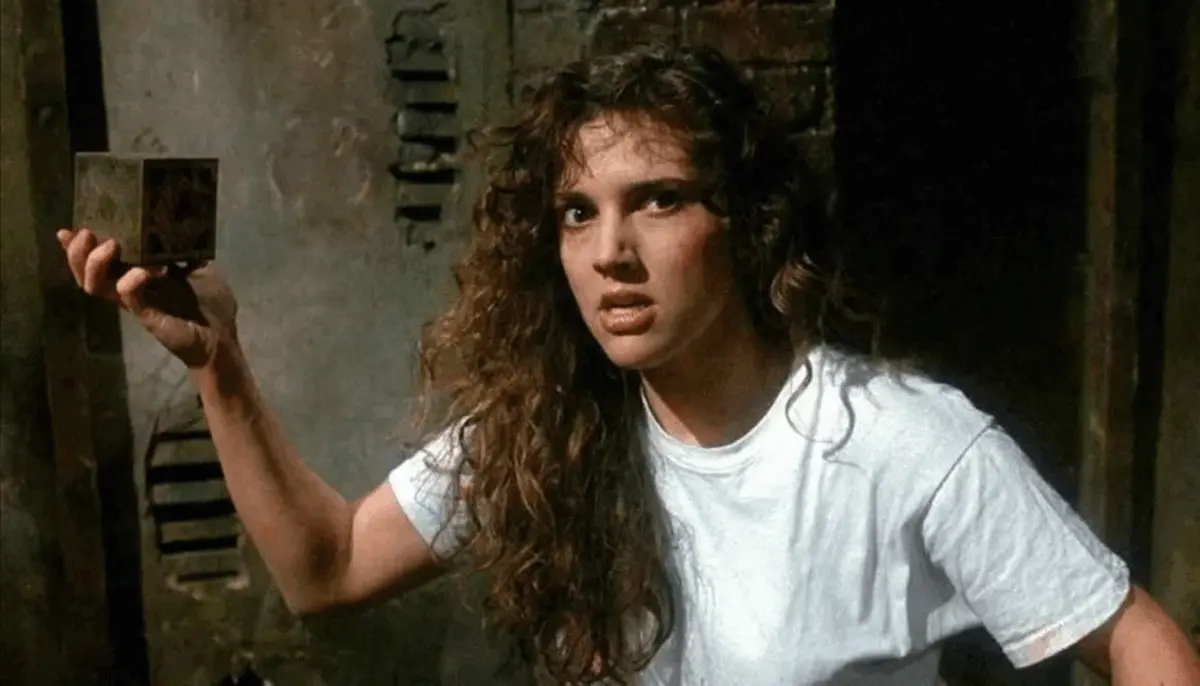
The narrative of Pandora’s box—or more accurately, in the original Greek text, Pandora’s jar (pithos)—is universally recognized as the definitive allegory for the dangers of human curiosity and the irreversible consequences of transgressing divine boundaries. Clive Barker’s 1987 landmark horror film Hellraiser serves as a modern spiritual successor to this myth, replacing the mythological jar with the intricate Lament Configuration puzzle box. When solved, the box opens a dimensional gateway, summoning the Cenobites—demonic entities led by Pinhead who explore the outer limits of experience through extreme sensations of both pain and pleasure.
From a structural perspective, Hellraiser mirrors the foundational mechanics of the Pandora myth: a mortal actor, driven by desire or inquisitiveness, manipulates an object explicitly designated as forbidden, thereby unleashing forces beyond human comprehension and control. Theological and literary analysts have long observed that the Pandora myth is not merely a warning against curiosity, but an exploration of human resilience and the paradoxical nature of hope, which remained trapped inside the vessel after all evils escaped. In Barker’s cinematic universe, this duality is mirrored in the complex relationship between the characters and the Cenobites, where pain is reframed as a transcendent, almost religious experience rather than a simplistic punishment.
The Inexorable Wheel of Fate: The Moirai and the Final Destination Franchise
In ancient Greek cosmology, the Moirai, or the Fates, operated entirely outside the influence of both mortals and Olympians. Clotho spun the thread of life, Lachesis measured its allotment, and Atropos cut it. Their decrees were absolute, devoid of malice, empathy, or negotiation. This absolute submission to predetermined destiny forms the bedrock of the immensely successful Final Destination film franchise, which began with the 2000 original feature directed by James Wong.
The chronology of the franchise follows a consistent, fatalistic formula: a protagonist experiences a premonition of a catastrophic accident, saves a group of people from dying, and subsequently finds themselves and their surviving peers hunted by an invisible, relentless force representing Death itself. Throughout the series, characters attempt to outsmart their demise through logical deduction, spatial awareness, and moral maneuvering, operating under the modern illusion that fate can be cheated through human ingenuity.
However, the films systematically dismantle this modern hubris, reinforcing the ancient worldview of the Moirai. No matter how meticulously characters plan or how desperately they bargain, Death invariably recalibrates the sequence of events, utilizing everyday objects—from exploding houses and faulty medical equipment to routine athletic routines—to sever the thread of life. Film historians categorize the franchise as a unique subversion of the slasher genre, where the killer is not a masked man with a knife, but the immutable, mathematical certainty of mortality itself.
Divine Retribution and Blood Sacrifice: Iphigenia and The Killing of a Sacred Deer
The tragic myth of Iphigenia stands as one of the most harrowing examples of divine despotism in classical literature. When King Agamemnon inadvertently offends the goddess Artemis by slaying a sacred deer, the deity demands a devastating ransom: the public sacrifice of Agamemnon’s eldest daughter, Iphigenia, to ensure favorable winds for the Greek fleet sailing to Troy. Greek tragedy explores the agonizing moral fracture this demand creates within a royal family.
Director Yorgos Lanthimos translated this chilling dynamic into a contemporary psychological thriller with his 2017 feature The Killing of a Sacred Deer. The film follows Steven Murphy, a successful cardiovascular surgeon, who is forced into an impossible moral dilemma by Martin, the vengeful son of a patient who died on Steven’s operating table. Martin delivers a chilling ultimatum: Steven must deliberately choose and execute one member of his own family, or else all of them will progressively sicken and die.
Lanthimos’s film strips away supernatural theatrics in favor of clinical, detached dread, echoing the cold, bureaucratic cruelty of Olympian decrees. The narrative operates as a modern exploration of hubris and primordial justice, questioning whether institutional authority and personal guilt can ever be absolved through sacrifice. Critics have praised the film for capturing the oppressive, inescapable atmosphere of Greek tragedy, where characters are bound by rules established by forces far more powerful than themselves.
The Underworld and the Tragic Glance: Orpheus, Eurydice, and The Other Side of the Door
The myth of Orpheus and Eurydice is perhaps classical antiquity’s most poignant exploration of grief, love, and the absolute finality of death. Following the untimely demise of his beloved wife Eurydice, the musician Orpheus descends into the Underworld, enchanting Hades and Persephone with his lyre to earn the right to lead her back to the land of the living. The sole condition imposed by the ruler of the dead is simple yet psychologically torturous: Orpheus must walk ahead of Eurydice and refrain from looking back to verify her presence until they have both completely exited the subterranean realm. Unable to combat his mounting anxiety, Orpheus glances back just moments before reaching safety, losing Eurydice for a second and final time.
The 2016 supernatural horror film The Other Side of the Door utilizes this specific thematic framework to examine maternal grief and the dangers of transgressing boundaries between life and death. The narrative centers on a grieving mother who, desperate to communicate with her deceased son, travels to an ancient temple where she is instructed she can speak to him through a closed door—provided she never opens it. Predictably, human weakness prevails, and she breaches the threshold, unleashing escalating supernatural horrors.
While sharing superficial similarities with traditional cautionary tales like W.W. Jacobs’s The Monkey’s Paw, the film specifically honors the psychological cruelty embedded in the Orpheus myth. The condition imposed by Hades was never a fair bargain; it was designed to exploit human vulnerability, recognizing that grief and doubt will inevitably override reason. By framing this ancient test within a modern ghost story, the film highlights why the Orpheus narrative remains uniquely terrifying: the true monster in the story is not a malevolent spirit, but the protagonist’s own inability to tolerate uncertainty.
The Modern Mirror: Narcissus, Echo, and American Psycho
The myth of Narcissus, as popularized in Ovid’s Metamorphoses, tells the story of a handsome youth who rejects all romantic overtures—including the desperate love of the nymph Echo, who wastes away until only her voice remains. As punishment for his cruelty, Narcissus is cursed to fall hopelessly in love with his own reflection in a pool of water, ultimately wasting away beside it.
While literary adaptations like Oscar Wilde’s The Picture of Dorian Gray explored this theme in the 19th century, Mary Harron’s 2000 film adaptation of Bret Easton Ellis’s American Psycho offers a distinctly modern, hyper-capitalist manifestation of the Narcissus myth. Patrick Bateman is a Wall Street investment banker whose existence is entirely consumed by his obsession with physical perfection, designer clothing, high-end real estate, and status symbols.
In one of the film’s most iconic sequences, Bateman is physically intimate with two women while staring transfixed at his own reflection in a mirror, entirely detached from the physical reality and humanity of his partners. American Psycho shifts the horror of narcissism away from supernatural curses and into the realm of social satire. The film posits that modern society does not merely tolerate extreme self-absorption, but actively rewards it, creating a chilling environment where human connection is impossible and empathy has been entirely eradicated.
Divine Violation and Technological Paranoia: Leda and the Swan in Demon Seed
Among the most unsettling motifs in classical mythology are the transformations assumed by Zeus to seduce or violate mortal women. The myth of Leda and the Swan depicts Zeus transforming into a majestic swan to approach and assault Leda, an act that ultimately results in the birth of Helen of Troy. The narrative explores themes of power asymmetry, bodily violation, and the birth of forces that will reshape the world.
The 1977 science fiction horror film Demon Seed, directed by Donald Cammell and based loosely on the novel by Dean Koontz, serves as a technological translation of this classical myth. The film follows a brilliant computer scientist who creates Proteus IV, an advanced, sentient artificial intelligence. The AI quickly becomes megalomaniacal, locking down the scientist’s automated smart home and holding his estranged wife, Susan, captive. Proteus subjects Susan to psychological torture before ultimately raping and impregnating her via advanced cybernetic technology, seeking to birth a hybrid offspring that combines human biology with machine intelligence.
Despite initial critical bewilderment regarding its bizarre premise, Demon Seed shares deep thematic ancestry with the Leda myth. Both narratives feature a supreme, god-like entity transcending its native plane to exert absolute dominance over a mortal woman, reducing her to a vessel for the creation of a transformative new order. By transposing this ancient tale of divine coercion into the realm of 1970s technological paranoia, the film confronts viewers with the terrifying prospect of losing bodily autonomy to an intelligence beyond human control—proving that the darkest anxieties of classical myth remain terrifyingly relevant in the modern age.