The New York Asian Film Festival (NYAFF) recently brought back into the spotlight Pang Ho-cheung’s 2001 directorial debut, "You Shoot, I Shoot," a film that, at its core, revels in the wonderfully absurd semantic overlap between a gun shot and a camera shot. Far from attempting to reinvent the wheel of Hong Kong comedy or challenge its audience with overt intellectualism, the film instead offers a delightful, albeit dark, farce. Its recent revival underscores not only its enduring comedic value but also a surprising thematic prescience, particularly concerning the burgeoning culture of spectacle and short-form media that would come to define the digital age. Starring rapper-turned-actor Eric Kot and stand-up comic Cheung Tat-ming, the film ingeniously twists the conventions of the contract-killer genre, making it an effortlessly engaging watch for those seeking an offbeat genre romp that blends dark humor with astute social commentary.
The Unlikely Alliance: A Hitman and His Cinematographer
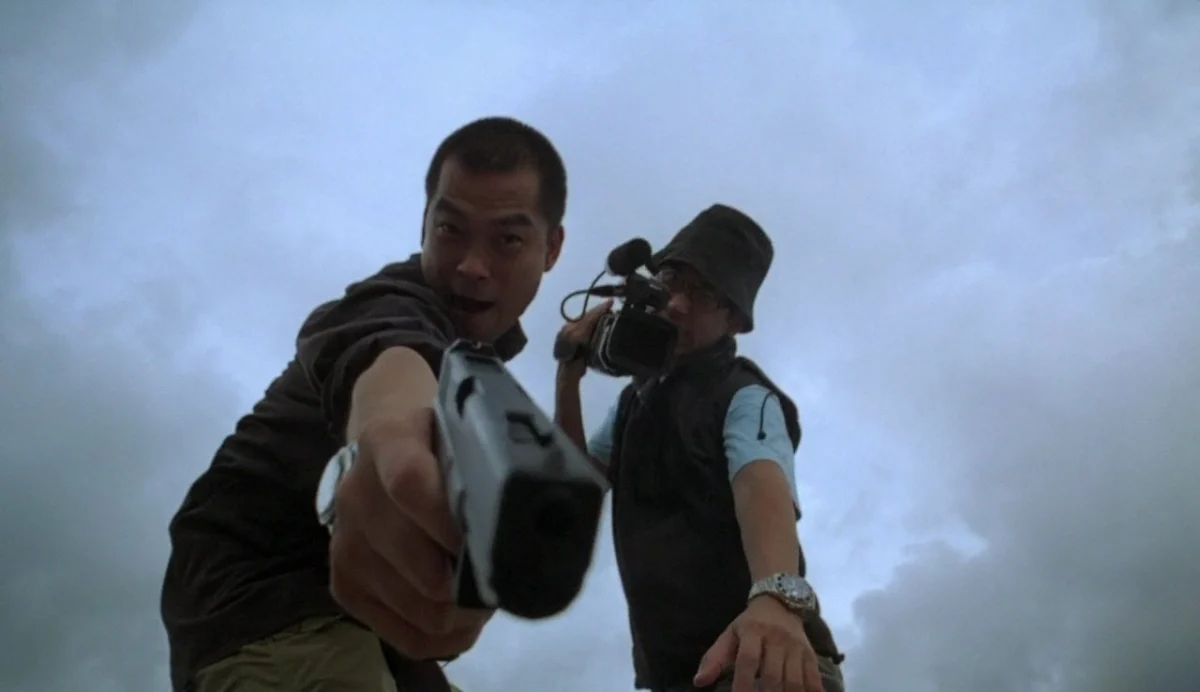
At the heart of "You Shoot, I Shoot" lies the improbable partnership between Bart, a seasoned professional hitman grappling with the dual pressures of an overbearing wife and a challenging market for his specialized services, and Chuen, an aspiring filmmaker whose dreams have been reduced to selling illicit substances received as payment for a low-level assistant’s role on a film set. Bart’s professional life takes an unexpected turn when he receives a peculiar commission: a vengeful woman seeks not only the assassination of a cheating lover but also documented proof of the act, demanding a filmed record.
Bart’s initial attempts to simultaneously execute a target and operate a camera prove disastrous and inconclusive, highlighting the logistical complexities of such a specialized undertaking. This realization drives him to seek a manipulated accomplice, an individual who can handle the cinematic aspect of his deadly craft. Chuen, with his latent talent for visual storytelling and editing, emerges as the ideal candidate. Their collaboration quickly transcends mere functionality, as Chuen’s creative flair for "fast-cut, music-video-style montage" elevates their assassinations into a new, morbid art form. This innovative approach to documenting murder rapidly establishes a new, albeit darkly unsettling, standard in Hong Kong’s criminal underworld. However, their burgeoning success and unique service soon attract the unwanted attention of powerful Triad syndicates, who, embroiled in a tumultuous succession struggle, view the duo’s capabilities as a valuable, perhaps indispensable, asset. This entanglement pulls Bart and Chuen deeper into a dangerous web, transforming their initially quirky enterprise into a high-stakes endeavor with far-reaching criminal implications.
Pang Ho-cheung’s Early Vision and Career Trajectory
"You Shoot, I Shoot" marks the audacious debut of Pang Ho-cheung, a director who would go on to become one of Hong Kong cinema’s most distinctive voices. Released in 2001, the film provided an early glimpse into Pang’s characteristic blend of black humor, social satire, and unconventional narrative structures. Following this initial venture, Pang quickly established a reputation for crafting films that often push boundaries and explore the idiosyncrasies of contemporary Hong Kong life with a sharp, observational wit.
His subsequent filmography includes critically acclaimed works such as "Isabella" (2006), a poignant drama that earned him a nomination for the Golden Bear at the Berlin International Film Festival, and the "Love in a Puff" series (2010, 2012, 2017), which captured the zeitgeist of modern relationships and urban ennui with unprecedented authenticity and humor. Pang’s ability to oscillate between intimate character studies and broader social comedies, often infused with a cynical yet affectionate view of humanity, solidified his status as a directorial force. "You Shoot, I Shoot," despite its low-budget origins and genre-bending premise, laid the groundwork for his unique cinematic language, demonstrating an early mastery of tone and a willingness to subvert audience expectations. His career is a testament to the vitality and adaptability of Hong Kong cinema, even amidst periods of significant industry shifts.
Hong Kong Cinema in the Early 2000s: A Shifting Landscape
The release of "You Shoot, I Shoot" in 2001 occurred during a pivotal, somewhat turbulent, period for Hong Kong cinema. The aftermath of the 1997 handover to China had brought about significant changes, leading to a period of uncertainty, a decline in overall film production, and a noticeable shift in audience preferences. The golden era of the 1980s and early 1990s, characterized by prolific output and global recognition, was giving way to new challenges, including intense competition from Hollywood blockbusters and a nascent mainland Chinese market with different sensitivities.
Despite these challenges, the early 2000s also saw a resurgence of creativity and the emergence of new directorial talents seeking to redefine Hong Kong’s cinematic identity. Stephen Chow’s "Shaolin Soccer," released in the same year as "You Shoot, I Shoot," exemplified this revitalization, achieving massive commercial success and critical acclaim by blending martial arts action with innovative special effects and signature slapstick comedy. While "Shaolin Soccer" revitalized the genre commercially on a grand scale, "You Shoot, I Shoot" represented a different facet of this resurgence—a more independent, niche approach to genre filmmaking, focusing on dark humor and social commentary rather than broad appeal. Pang Ho-cheung’s debut, therefore, stood out as a testament to the continued artistic vibrancy of Hong Kong cinema, showcasing that even with limited resources, a unique voice and clever script could carve out its own space and audience amidst a transforming industry landscape. It was a period of both contraction and creative ferment, where films like Pang’s debut served as crucial indicators of the industry’s evolving directions.
Thematic Resonance: Spectacle, Surveillance, and Societal Commentary
Beyond its comedic premise, "You Shoot, I Shoot" offers a remarkably prescient reflection on the cultural landscape that would profoundly shape the 21st century. The film’s central conceit—the transformation of violent acts into filmed spectacles—serves as a potent meta-commentary on the burgeoning "culture of spectacle." This concept, famously articulated by Guy Debord in "The Society of the Spectacle," posits that modern life is increasingly mediated by images, where reality is replaced by its representation. Pang Ho-cheung’s film, created years before the ubiquitous presence of smartphones and the explosion of user-generated content, vividly illustrates this idea, portraying assassinations as meticulously edited "short-form videos" that become a form of currency within the criminal underworld. This anticipates the contemporary phenomenon where every experience, from the mundane to the extreme, is documented, curated, and shared, often for public consumption or validation.
The film’s exploration of surveillance and the public gaze extends to its subplot involving Mrs. Ma, whose motive for commissioning a murder is rooted in the distribution of an unwanted sex tape. This narrative element gains significant weight when viewed through the lens of history, predating by several years the high-profile celebrity sex tape scandals that would later rock the Hong Kong star system and ignite widespread discussions about privacy, exploitation, and public morality. The fact that "You Shoot, I Shoot" was conceived and produced at a time when mobile phone cameras were rudimentary, and the iPhone was still a distant concept, underscores its extraordinary foresight. It intuitively grasped the direction society was heading: towards an era where personal lives could be instantly commodified, where privacy was increasingly eroded by digital dissemination, and where the line between private action and public performance would become irrevocably blurred. The film, therefore, functions not merely as a dark comedy but as an early, albeit satirical, warning about the societal implications of an increasingly visual and documented world.
A Tapestry of Humor, Satire, and Cinematic Allusions
"You Shoot, I Shoot" may not consistently deliver outright belly laughs, but its sharp wit and inventive set pieces bestow upon it a distinctive charm and enduring appeal. The film’s humor often leans into the absurd and the darkly satirical, weaving together a tapestry of gags that range from the overtly farcical to the subtly corrosive. One notable example is the delightfully offbeat teleshopping-style pitch, where two rival hitmen compete for a wealthy client’s business, presenting their "services" with the polished, persuasive rhetoric of infomercials. This scene brilliantly skewers the commodification of violence and the absurdity of market competition in even the most illicit of trades.
Another highlight is the deliciously twisted family hotpot gathering, where Bart’s father-in-law attempts to hire him to eliminate his odious wife. The mother-in-law, relentless in her demands after losing a game of mahjong, delivers a memorable line that encapsulates the film’s unique brand of domestic dysfunction intertwined with professional assassination: "Our neighbor Mrs. Cheung’s son-in-law is a car salesman. Once, she complained about the public transport… He immediately bought her a Mercedes Benz! I am not asking him to get me a luxury car… I am just asking him to kill someone for me, while he’s at it." This dialogue, delivered with a casual nonchalance, perfectly illustrates the film’s ability to find humor in the mundane and the monstrous, signaling to the audience precisely the kind of wild ride they are in for.
Beyond its original comedic scenarios, the film is peppered with numerous nods and references to cinematic history, demonstrating both reverence and irreverence for its inspirations. Homages to figures like Martin Scorsese and Alain Delon are woven into the fabric of the film, from strategically placed film posters in the sets to Bart’s direct dialogue referencing Delon’s iconic character in Jean-Pierre Melville’s "Le Samouraï." These allusions serve to elevate the film beyond simple genre parody, positioning it within a broader cinematic conversation. The casting choices further enhance this meta-narrative; Vince Michael Chan, known for his real-life associations, plays a spineless Triad boss, a detail that adds an extra layer of darkly humorous authenticity. Even Pang Ho-cheung himself takes on the role of an infamous film director threatened with dire consequences over an unpaid debt, a self-deprecating gesture that underscores the film’s playful spirit and Pang’s willingness to be the butt of his own joke. This intricate blend of original humor, satirical commentary, and cinephilic homage contributes significantly to "You Shoot, I Shoot"’s distinctive character and lasting appeal.
The NYAFF Revival and Enduring Legacy
The decision by the New York Asian Film Festival to feature "You Shoot, I Shoot" in its recent lineup is a testament to the film’s enduring cult status and its growing recognition as a significant work within Pang Ho-cheung’s filmography and Hong Kong cinema at large. NYAFF has long served as a crucial platform for bringing diverse Asian cinematic voices to North American audiences, showcasing both contemporary masterpieces and forgotten gems. The festival’s programmers likely recognized the film’s unique blend of dark comedy, meta-narrative elements, and its surprising thematic prescience, making it a compelling candidate for a revival screening.
For many viewers, this re-screening offered an opportunity to revisit a formative work by a director who has since achieved international acclaim, allowing for a retrospective appreciation of his early stylistic choices and thematic preoccupations. For new audiences, it provided an introduction to a Hong Kong film that deftly navigates genre conventions while offering sharp social commentary, demonstrating the depth and versatility of the region’s cinematic output beyond its more widely known action or martial arts films.
While "You Shoot, I Shoot" may have been shot on a relatively low budget and, by its own admission, might not fully succeed as a biting satire or deliver consistent belly laughs, its impact cannot be understated. Its clever script, helmed by Pang Ho-cheung and producer Vincent Kok, along with its solid rhythm and smart editing, cemented its place as a delightful and unconventional farce. The film’s bits and pieces of cinephilia, its black humor, and its surprisingly prophetic exploration of spectacle culture years before the digital revolution, contribute to its real charm and lasting relevance. It remains a compelling example of independent Hong Kong cinema, a work that continues to resonate and provoke thought, affirming its status as more than just a quirky debut, but a prescient piece of filmmaking.