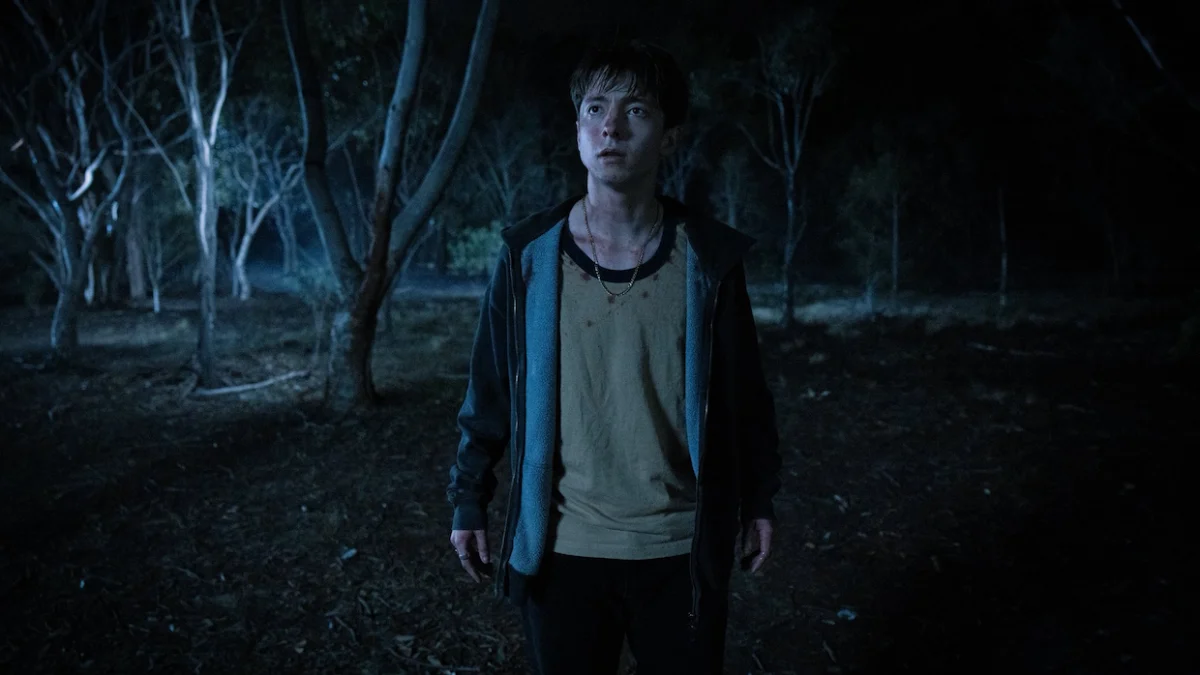
Adrian Chiarella’s debut feature, Leviticus (2026), immediately immerses audiences in a chilling narrative rooted in an archetypal horror trope: a seemingly innocuous "little death" that precipitates a far greater tragedy. The film’s cold open establishes its premise with stark brutality, depicting a lesbian lifeguard succumbing to the seductive allure of an invisible entity in a poolside shower. This moment of illicit pleasure is swiftly transformed into a scene of horrific murder, setting the tone for a story that masterfully blends supernatural terror with profound social commentary. The sinister entity, which preys upon its victims by manifesting as their deepest desire, is revealed to be the ghastly progeny of a hex inflicted upon gay teenagers by a local church, ostensibly as a form of conversion therapy. This conceptual hook, a clever subversion of the horror genre’s longstanding fascination with teenage sexuality and mortality, is built upon a pious dictum frequently weaponized to control queer youth: the insidious belief that their desires are inherently destructive and will ultimately lead to their demise.
This potent metaphor for homophobia – a pervasive and inescapable force that twists private longing into public fear and ostracism – serves as a blunt but effective instrument of identification within Leviticus. It represents a brute-force appeal for empathy in an era often characterized by its callousness towards marginalized communities. Director Adrian Chiarella’s creative impetus for the film was a direct response to a discernible recent rise in bigotry and a concerning regression from the progress made over past decades towards the elusive goal of queer security and safety. His work reflects a critical contemporary moment where advancements in LGBTQ+ rights are increasingly challenged, prompting a renewed urgency in artistic expressions that confront these societal headwinds.
The Genesis of a Modern Parable: Director’s Vision and Influences
Speaking on the origins of the project, Chiarella revealed a deeply personal connection to the subject matter. "I started thinking about what would be personal for me," he explains, "and horror movies were something that I turned to as a young queer teenager. I don’t think I was alone in that. The genre has been important to the community for a very, very long time." This sentiment resonates widely within LGBTQ+ communities, where horror films have long provided a cathartic outlet and a mirror for experiences of alienation, otherness, and existential fear. The genre’s inherent exploration of the monstrous and the abnormal often parallels the lived experiences of queer individuals navigating a world that frequently pathologizes their identities.
Chiarella fondly recalls the formative impact of films like the Nightmare on Elm Street series, particularly Freddy’s Revenge (1985), which many critics and fans interpret as a powerful, albeit veiled, allegory for the struggles of a young man grappling with his repressed homosexuality. The film’s protagonist, Jesse Walsh, battles an invading demonic force that seeks to possess his body, a metaphor often read as the internal struggle of coming to terms with one’s queer identity in a heteronormative society. Another significant influence cited by Chiarella is John Carpenter’s The Thing (1982), a masterclass in paranoia that "plumbs the tension between the self and the other, not really knowing if you can trust the person in front of you," as he puts it. This theme of existential distrust and the fear of what lies beneath the surface directly informs the psychological landscape of Leviticus. The director further notes, "I was always told not to watch those films, which only made me want to watch them more," highlighting the allure of forbidden narratives for those seeking to understand their own suppressed realities.
These forbidden yet fruitful lodestars provide a compelling entry point and a clear marketing hook for Leviticus. However, the film transcends mere homage, rooting its tersely tender parable in a profound specificity. The narrative is spiritually and spatially confined to an industrial town nestled within the remote Australian boondocks, a setting further constricted by the pervasive influence of a cult-like religious community. This deliberate choice of locale enhances the sense of isolation and oppression, making the characters’ struggles feel both universal and acutely localized.
Plot Development and Character Dynamics
The story centers on Naim (portrayed by Joe Bird), a shy newcomer to the town, who finds himself drawn to the brashly charismatic Ryan (Stacey Clausen), a classmate. Their burgeoning romance forms the emotional core of the film, quickly establishing the stakes of intimacy and vulnerability in a hostile environment. A pivotal scene captures their dynamic: "Is there anything you’re not afraid of?" the bolder Ryan taunts, pinning Naim to the floor of an abandoned building. This moment of playful aggression culminates in a kiss, a symbolic sealing of their connection. Yet, mid-lip-lock, Naim catches his own reflection, balking at the sight. This visceral reaction powerfully illustrates the pervasive fear of the self that grips the film’s queer characters, a self-aversion internalized from societal prejudice.
The plot gains further complexity with the introduction of Hunter (Jeremy Blewitt), the closeted son of the town’s preacher. Hunter’s character introduces a layer of internal conflict within the oppressive religious structure, as his own suppressed desires clash with his father’s dogmatic teachings. His bizarre and violent tryst with Ryan disrupts Naim’s burgeoning romance, igniting a destructive jealousy in Naim. In a moment of desperate miscalculation, Naim tattles on Hunter and Ryan, expecting a lesser punishment than outright exorcism, but inadvertently unleashing a chain of events with far more dire consequences. The remainder of the film sees Naim grappling with the profound guilt of this betrayal, embarking on a harrowing journey of atonement. Chiarella reflects on this narrative choice, stating, "Horror movies are always about someone committing a transgression, and whatever horrible thing that comes after is because of this." In Leviticus, the transgression is not merely a moral failing but a deeply embedded societal one, born from fear and internalized shame.
The "horrible thing" that ensues vividly demonstrates the desperate, life-or-death necessity for queer camaraderie and solidarity. As the boys become increasingly isolated in their plight, the monster stalking them exploits their vulnerability. Its nature is particularly insidious: it only appears when its victim is alone, yet it possesses the terrifying ability to replace a loved one when their back is turned. This horrifying characteristic forces Ryan and Naim to make the agonizing decision to separate, believing that proximity only increases the risk of a fatal encounter. Their desperate search for answers leads them to the partner of the woman killed in the opening scene, who now resides in a local hospital. In a brutal twist on the classic horror trope of the crazed recluse, this woman is not simply mad but tragically isolated, forced to surround herself with people to survive, yet more alone than ever due to the very nature of her torment.
Themes of Betrayal and Conditional Love
The film masterfully explores themes of false allyship and predatory love, showing how even seemingly supportive figures can become agents of oppression. Hunter’s sister initially extends an olive branch to Naim and Ryan, only for a bait-and-switch to reveal her true, manipulative nature. A brief but devastating gesture of care from Naim’s mother (Mia Wasikowska) immediately follows a moment of profound betrayal, underscoring the precariousness of affection in a judgmental environment. Wasikowska’s character later tells her terrified son, "We need fear," blurring the critical line between genuine protection and insidious oppression. This statement encapsulates the complex dynamic within conservative families where fear, often rooted in religious dogma, is presented as a means of safeguarding, even as it actively harms. Chiarella explains his intention: "I wanted to create a world where you weren’t sure you could trust even the real people around you anymore." This pervasive atmosphere of distrust amplifies the boys’ isolation, making every interaction a potential trap.
The isolated boys drift through barren landscapes and weathered architecture, the production design itself a character, dripping with dreary, vacant hostility. These vague, slightly anonymous settings are a deliberate choice, reflecting Chiarella’s desire to craft a "modern biblical parable" in a setting that juxtaposes industrial blight with pastoral features. "We wanted to play with this theme of what’s man-made and what comes from the universe," he elaborates, evoking the inherent tension between human nature, with its innate desires and complexities, and "the rules and the edicts we live by," particularly those imposed by restrictive religious doctrines.
Visual Storytelling and Perception
On a visual level, Leviticus is not only metaphorically rich but also vividly cinematic. Much of the action – glimpsed furtively via windows, mirrors, and security cameras, or impassively by uncaring bystanders – is dictated by what the characters can and cannot see. Those unburdened by the curse are unable to perceive it, a symbolic blinkering that powerfully echoes the willful ignorance and denial often directed at queer teens. Their sexuality, as Chiarella observes, is frequently dismissed by others who believe it "is just something they’re putting on, or that other people have convinced them to do." This societal blindness to the reality of queer identity is terrifyingly literalized in the film’s central conceit. Even Naim’s own eyes constantly deceive him, against all reason, mistaking Ryan’s demonic doppelgänger for the real person, highlighting the psychological toll of trauma and the fragility of perception. In this film, seeing is not just believing; it is an act of survival, and its absence is a weapon.
Thematic Depth: Biblical Context and Conversion Therapy
The title Leviticus is deliberately provocative and deeply symbolic. It directly references the Old Testament book often cited by fundamentalist Christian groups to condemn homosexuality (e.g., Leviticus 18:22 and 20:13). By titling his film thus, Chiarella immediately grounds his narrative in the very scripture used to justify the bigotry and "conversion therapy" that fuels the film’s central horror. This act of reclaiming and subverting the oppressive text transforms it into a lens through which to examine the profound damage inflicted by religious homophobia.
Conversion therapy, the practice of attempting to change an individual’s sexual orientation or gender identity, has been widely discredited by major medical and mental health organizations worldwide, including the American Medical Association, the American Psychological Association, and the Australian Psychological Society. These practices, often carried out in religious settings, have been linked to severe psychological distress, depression, anxiety, self-harm, and increased suicidal ideation among LGBTQ+ youth. Despite mounting evidence of its harm and increasing legislative bans in many jurisdictions (e.g., parts of Australia, Canada, the UK, and numerous US states), conversion therapy continues to be practiced covertly in some communities, particularly in religiously conservative regions like the "boondocks" depicted in the film. Chiarella’s decision to make this practice the origin of his supernatural entity is not merely a clever plot device; it is a potent dramatization of the real-world trauma and psychological violence inflicted upon queer individuals by such religiously motivated interventions. The monster in Leviticus embodies the internalized shame and external threat that conversion therapy breeds, a manifestation of the "curse" placed upon queer youth by those who claim to save them.
Broader Implications and Cultural Resonance
Leviticus arrives at a pivotal moment when mainstream queer media has largely moved beyond narratives solely focused on crisis and prejudice, increasingly celebrating queer joy and identity. Yet, Chiarella’s film serves as a timely and necessary "back-to-basics" confrontation of the adversity and disquietude that many too readily imagine to be relics of the past. The director’s motivation stems from a recognized "backward slide" in progress, evidenced by renewed legislative attacks on LGBTQ+ rights globally, rising hate crimes, and the continued prevalence of discriminatory rhetoric. In Australia, while same-sex marriage was legalized in 2017, debates around religious freedom laws continue to pose threats to LGBTQ+ protections, particularly in schools and faith-based organizations. Leviticus provides a vital artistic counter-narrative, reminding audiences that the struggle for queer security and safety is far from over.
However, the film’s ambiguous yet undeniably hopeful ending also exemplifies its modernity, consciously eschewing the oppressive doom that often characterized queer films of earlier eras. Instead, it offers something far more complex and nuanced. "We took that idea of how, in the final frame of a lot of horror movies, the monster comes crawling back, and you realize it may not actually be dead," Chiarella reveals. "I thought about what that would mean in this film – that whatever trauma these boys have been through may not go away for a very long time. It may never go away." This powerful conclusion suggests that while individual battles may be won, the systemic scars of homophobia and the internalized trauma it inflicts are deeply ingrained and persist. The monster, in this context, represents not just an external threat but the enduring psychological impact of oppression. The film’s savvy enactment of horror convention thus fuses seamlessly with its profound figurative design, leveraging the genre’s visceral tremors to unearth something terrible, intimately personal, and profoundly true about the ongoing queer experience.
By crafting a narrative that is both viscerally terrifying and intellectually resonant, Leviticus contributes significantly to the evolving landscape of queer cinema and the horror genre. It acts as a powerful cultural artifact, inviting audiences to confront uncomfortable truths about societal prejudice, the lingering wounds of religious dogma, and the enduring resilience required to navigate a world that still struggles to embrace all forms of love and identity. The film is poised to spark crucial conversations about mental health, religious freedom, and the persistent need for empathy and understanding in a world where the monsters of bigotry continue to lurk.