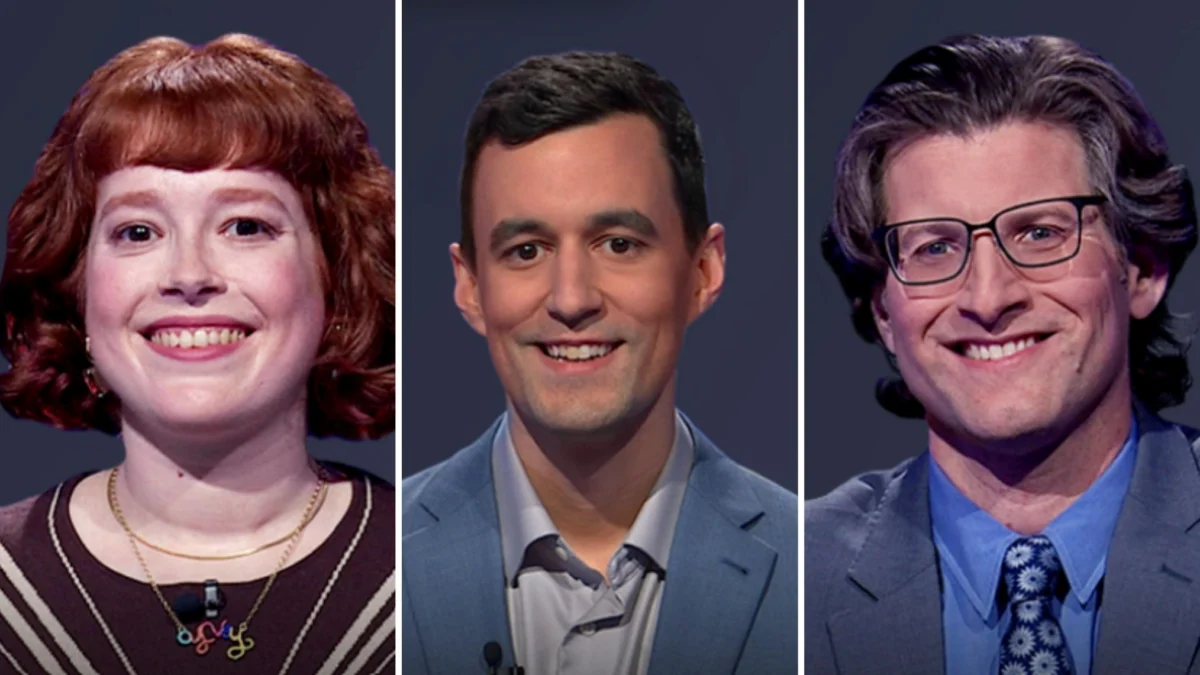
The landscape of the long-running syndicated game show Jeopardy! shifted significantly during the broadcast on May 20, as the reigning ten-day super-champion, Tristan Williams, saw his impressive winning streak come to a conclusion. Williams, a data scientist from Lincoln, Nebraska, had entered the match with the momentum of a "super-champ," a title reserved for those who surpass the ten-win milestone. However, the evening belonged to Chris D’Angelo, a content manager from Washington, D.C., whose last-second correction during the Final Jeopardy! round secured him a victory and the title of new champion. The game was a testament to the high-stakes nature of the program, where a single stroke of a pen can differentiate between a successful title defense and a narrow defeat.
The Ascent of Tristan Williams: A Ten-Day Legacy
Tristan Williams entered the May 20 episode with a resume that placed him among the elite players of the current season. Having secured ten consecutive wins, Williams had amassed a total of $221,902 in prize money. His background as a data scientist appeared to serve him well throughout his run, characterized by efficient clue selection and a disciplined approach to wagering. By reaching the ten-win mark on the preceding Tuesday, Williams not only solidified his place in the upcoming Tournament of Champions but also joined an exclusive group of contestants who have navigated the "post-super-champ" era with such longevity.
Williams’ journey began with a series of dominant performances where his buzzer speed and broad knowledge base frequently left opponents struggling to keep pace. However, as is often the case with long-running champions, the cumulative pressure of consecutive tape days—where multiple episodes are filmed in a single afternoon—can begin to impact performance. Entering his eleventh game, Williams faced a formidable pair of challengers: Allegra Rosenberg, a writer from Skokie, Illinois, and Chris D’Angelo.
Chronology of the Match: The Jeopardy! Round
The game began with a competitive spirit that suggested Williams would not have an easy path to his eleventh victory. Early in the first round, Chris D’Angelo demonstrated a quick reflex on the signaling device, establishing a narrow lead. The pivotal moment of the opening round occurred on the eleventh clue, when Williams uncovered the first Daily Double in the category "Bible People in the Quran."
At the time, Williams held $2,600, trailing D’Angelo’s $3,600. Opting for a strategic but cautious wager of $1,600, Williams faced a clue regarding a royal figure who "set forth from her country and reached Jerusalem" according to a tafsir (commentary). Williams responded with, "Who is Esther?" This proved incorrect, as the intended response was the Queen of Sheba. The miss resulted in a $1,000 deficit for Williams, allowing D’Angelo to consolidate his lead.
By the end of the first round, the scoreboard reflected a tightened race. D’Angelo led with $5,200, while Williams had recovered some ground to reach $4,400. Allegra Rosenberg trailed with $2,000. The statistics from the first half indicated a high accuracy rate across the board, but the missed Daily Double had denied Williams the opportunity to take control of the podium early on.
Double Jeopardy!: Tactical Shifts and Missed Opportunities
As the game moved into the Double Jeopardy! round, the intensity increased. Williams, utilizing his experience, began to chip away at D’Angelo’s lead. On clue 17, Williams found the second Daily Double in the category "We’ve Got Your Back." With $12,000 to D’Angelo’s $13,600, the moment offered a chance for Williams to reclaim the lead.
He wagered $3,500 on a clue describing a condition where the space inside the backbone becomes too small for the nerves, derived from the Greek for "narrowing." Williams guessed "compression," which was ruled incorrect. The correct response, "spinal stenosis," cost him $3,500, dropping his total to $8,500. Despite the loss, Williams remained in second place, though the gap between him and D’Angelo widened.
The final Daily Double of the game was found by Allegra Rosenberg on clue 21. Holding $5,200, Rosenberg took a significant risk, wagering $5,000 in the category "‘Ora’ Framing." The clue referenced Alexander Hamilton’s description of a "quadrennial institution" that he deemed "at least excellent" if not perfect. Rosenberg was unable to provide a response, failing to identify the "Electoral College." This miss proved devastating for her standings, as she plummeted to a mere $200, effectively turning the remainder of the round into a two-person race between D’Angelo and Williams.
At the conclusion of Double Jeopardy!, the scores stood as follows:
- Chris D’Angelo: $12,800
- Tristan Williams: $9,700
- Allegra Rosenberg: $1,400
The Final Jeopardy! Climax: A Last-Second Pivot
The category for the final round was "The 20th Century," a broad topic that often requires specific historical knowledge. The clue provided was: "51 days after this event, Edward Teller said the United States had lost ‘a battle more important & greater than Pearl Harbor.’"
The gravity of the clue rested on the identification of a mid-century event that fundamentally altered the global geopolitical landscape. Allegra Rosenberg, in third place, offered "Hiroshima + Nagasaki," which was incorrect. She wagered $1,101, leaving her with a final total of $299.
Tristan Williams, needing a correct response and a strategic wager to potentially overtake D’Angelo, responded with "What is the Fall of Saigon?" This was also incorrect. Williams had wagered $3,101, bringing his final total to $6,599.
The outcome then rested on Chris D’Angelo. Initially, D’Angelo’s monitor showed that he had written "What is the Tet Offensive?" However, in a display of "trusting one’s gut," D’Angelo had struck through his initial thought and written "What is the Sputnik Launch?" underneath it. This correction proved to be the winning move. The launch of the Soviet satellite Sputnik 1 on October 4, 1957, triggered a period of intense anxiety in the United States, often referred to as the "Sputnik crisis," which led directly to the creation of NASA and the acceleration of the Space Race. Edward Teller, a physicist known as the "father of the hydrogen bomb," made his famous comparison to Pearl Harbor to underscore the technological and strategic vulnerability the U.S. felt at the time.
D’Angelo wagered $6,601, bringing his winning total to $19,401. Analysis of the wagering suggests that had D’Angelo remained with his incorrect first answer, he would have finished with $6,199—just $400 shy of Williams’ final score. The victory was secured purely through the eleventh-hour correction.
Historical Context: The Impact of Sputnik and Edward Teller
The clue’s reference to Edward Teller and the Sputnik launch highlights a critical juncture in 20th-century history. Teller’s reaction reflected a widespread sentiment among the American scientific and military establishment. The "battle" he referred to was not one of conventional warfare, but of scientific supremacy and prestige.
The 51-day timeframe mentioned in the clue refers to the period between the launch of Sputnik 1 in October 1957 and the subsequent failure of the American Vanguard TV3 satellite launch in December 1957. This period solidified the perception that the United States was trailing the Soviet Union in aerospace technology. By correctly identifying this event, D’Angelo demonstrated an ability to synthesize historical quotes with specific chronological markers—a hallmark of successful Jeopardy! contestants.
Implications for the Season and the Tournament of Champions
While Tristan Williams’ streak has ended, his performance throughout May has been a highlight of the season. With ten wins and over $221,000 in earnings, Williams is guaranteed a high seed in the next Tournament of Champions (ToC). His exit follows a trend in recent seasons where "super-champs" find their streaks ended by challengers who capitalize on Daily Double misses or late-game surges.
Data scientists and analytical players have historically performed well on Jeopardy!, and Williams’ run will likely be studied by future contestants for his efficient category management. His departure opens the door for Chris D’Angelo to begin his own journey. As the new champion, D’Angelo will return for his second game on Thursday, facing a new set of challengers and the pressure of defending his title.
Conclusion: The Margin of Victory
The May 20 episode of Jeopardy! serves as a case study in the importance of poise under pressure. Chris D’Angelo’s victory was not just a result of his cumulative knowledge, but of his ability to reassess his conclusions within the thirty-second window of the Final Jeopardy! round. For Tristan Williams, the loss marks the end of a dominant chapter, but his entry into the Tournament of Champions ensures that his Jeopardy! story is far from over.
The show continues to air weekdays, maintaining its status as a staple of American television by delivering moments of intellectual tension and dramatic reversals of fortune. As the season progresses, the focus now shifts to whether D’Angelo can build upon this momentum or if the revolving door of champions will continue to turn. For now, the "Sputnik" correction remains one of the most consequential last-minute decisions of the season.