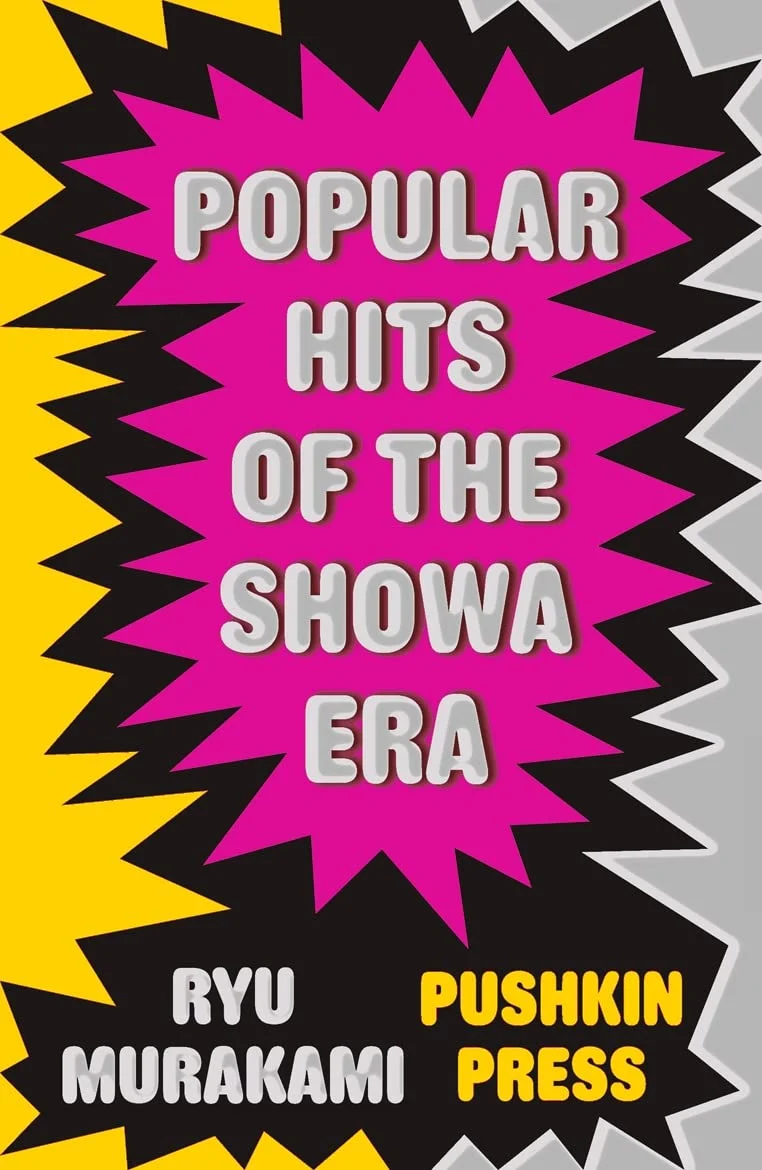
"Popular Hits of the Showa Era" is a novel by acclaimed Japanese author Ryu Murakami, first serialized in "Weekly Playboy" before its book release by Shueisha in 1994. The novel saw its English translation by Ralph McCarthy published by W. W. Norton in 2011, followed by another edition from Pushkin Press in 2013, expanding its reach to an international audience. Published in the same year as his equally impactful work, "Piercing," "Popular Hits of the Showa Era" presented a markedly different facet of Murakami’s versatile literary talent. This particular work distinguishes itself by constructing an increasingly absurd and brutally violent conflict between two disparate groups of social outsiders, blending elements of black humor, extreme violence, wistful nostalgia, and sharp social satire. It positions itself closer to the thematic vein of his 1987 novel "Sixty Nine," albeit with a significantly intensified and explicit layer of gore and splatter.
Genesis and Context: Murakami’s Oeuvre and 1990s Japan
To fully appreciate the narrative depth and satirical bite of "Popular Hits of the Showa Era," it is crucial to understand both Ryu Murakami’s established literary landscape and the socio-cultural context of Japan in the mid-1990s. Murakami, a prolific and often controversial author, has built a formidable reputation for his unflinching exploration of the darker, more transgressive facets of modern life. His works frequently delve into themes of alienation, consumerism, gratuitous violence, sexual obsession, and the disillusionment of youth, often rendered with a stark, unsettling realism or a surreal, hallucinatory intensity. From his debut "Almost Transparent Blue" (1976), which captured the hedonistic drug culture of post-war youth, to "Coin Locker Babies" (1980), a sprawling epic of vengeance and survival, Murakami has consistently challenged societal norms and pushed literary boundaries. "Popular Hits of the Showa Era" stands as a testament to this trajectory, demonstrating his willingness to experiment with genre and tone while maintaining his signature thematic preoccupations. It showcases his ability to craft narratives that are both viscerally engaging and intellectually provocative, even when venturing into the realm of the absurd.
The novel’s title itself, "Popular Hits of the Showa Era," is steeped in Japanese cultural history. The Showa Era, spanning from 1926 to 1989, was a period of profound transformation for Japan, encompassing the devastation of World War II, the miraculous post-war economic recovery, and the subsequent emergence as a global economic powerhouse. For many Japanese, especially those who came of age during its later decades, the Showa Era evokes a powerful sense of nostalgia—a time of perceived simpler values, communal solidarity, and a distinct cultural identity forged through shared experiences. The "popular hits" from this era are more than just songs; they are sonic touchstones, repositories of collective memory and sentimentality. Murakami’s ironic deployment of this title, juxtaposing it with scenes of extreme violence and social dysfunction, serves as a potent critique, highlighting a disconnect between a romanticized past and a troubling present.
Published in 1994, the novel also emerged from a specific socio-economic climate in Japan, often referred to as the "Lost Decade." Following the spectacular collapse of the economic bubble in the early 1990s, Japan entered a prolonged period of stagnation, characterized by economic uncertainty, rising unemployment, and a palpable sense of disillusionment. This era saw a questioning of traditional societal structures and values, contributing to feelings of alienation and aimlessness, particularly among younger generations. The characters in "Popular Hits of the Showa Era"—both the disaffected young men and the marginalized divorced women—can be seen as products of this societal malaise. Their inability to connect, their search for identity, and their eventual recourse to violence reflect the anxieties and frustrations simmering beneath the surface of a seemingly affluent yet increasingly fragmented society. Murakami deftly taps into these underlying tensions, exaggerating them to a grotesque degree to expose deeper truths about human nature and social pathology.
Narrative Arc: The Escalation of Absurdity and Violence
The core of "Popular Hits of the Showa Era" lies in its meticulously constructed, albeit increasingly outlandish, narrative of conflict. Murakami introduces two distinct groups, both existing on the fringes of mainstream society, whose paths tragically intersect in a spiral of vengeance.
The first group consists of six young men, aimless and adrift, among them Ishihara, Nobue, and Sugioka. These individuals are depicted as profoundly disconnected, not only from society but also from each other. They possess few discernible common interests and appear largely incapable of meaningful communication, frequently bursting into inexplicable fits of intense laughter and performing absurd, seemingly involuntary movements. Despite their profound social awkwardness and lack of genuine intimacy, they coalesce for late-night gatherings, donning costumes and engaging in karaoke sessions, passionately singing popular songs from the Showa Era. This shared ritual, however superficial, represents one of their few anchors to a collective identity, albeit one built on imitation and performative behavior.
Counterbalancing them are the six divorced women who form the Midori Society. Their unity is equally fragile, founded simply on the shared name "Midori." Like their male counterparts, these women in their thirties are bound less by deep personal connection than by a pervasive sense of loneliness, the rigid routines of their lives, and their collective position outside the conventional social mainstream. They are individuals who, for various reasons, have been cast aside or have drifted away from the traditional family structures and societal expectations, mirroring the aimlessness of the young men in a different demographic.
The spark that ignites the novel’s central conflict is as sudden as it is brutal. Sugioka, one of the young men, impulsively commits a heinous act, murdering Yanagimoto Midori on the street with extreme brutality. What is even more disturbing is his subsequent, matter-of-fact narration of the crime to his comrades, an act that, within their warped moral framework, immediately elevates him to the status of a hero. This reaction underscores the profound ethical vacuum within their group. The surviving members of the Midori Society, having identified Sugioka, swiftly retaliate, exacting their revenge by killing him.
The news of Sugioka’s death reaches Ishihara, who informs the remaining young men. Fuelled by a desire for retribution and an increasingly tribalistic loyalty, they acquire a Tokarev pistol from a suspicious hardware dealer and meticulously plan their own counter-retaliation. From this pivotal moment, the narrative descends into a relentless cycle of revenge inspiring further revenge. What commences with a single knife murder rapidly escalates through shootings, sophisticated guerrilla tactics, the deployment of rocket launchers, and eventually culminates in destruction on a scale reminiscent of full-blown warfare. Murakami masterfully chronicles this escalation, transforming a localized feud between two alienated groups into a hyperbolic, yet chillingly plausible, depiction of societal breakdown.
Thematic Resonance: Satire, Alienation, and Purpose Through Destruction
Murakami’s "Popular Hits of the Showa Era" is far more than a mere chronicle of violence; it is a profound social satire, leveraging its absurd premise to dissect critical aspects of modern Japanese society.
The most immediately striking satirical element is the profound contrast between the novel’s title and its actual content. The phrase "Popular Hits of the Showa Era" conjures images of heartwarming nostalgia, a gentle celebration of Japan’s musical heritage. Indeed, each chapter of the novel is explicitly linked to a specific song from that era, providing a structural framework. Yet, instead of a sentimental journey, these songs serve as the strangely sentimental, almost melancholic, backdrop to a blood-soaked confrontation between deeply alienated young men and frustrated middle-aged women. This juxtaposition is deliberately jarring and serves to amplify the grotesque nature of the events unfolding. The familiar melodies, often associated with comfort and shared memory, become an eerie counterpoint to acts of killing and destruction, underscoring the novel’s central irony.
These Showa-era songs are not just a narrative device; they represent one of the few, albeit superficial, connections the characters have to a shared culture and, by extension, to each other. The young men, in particular, struggle profoundly to relate to others or to find a meaningful place in society. However, they invest enormous energy and passion into their karaoke sessions. Music, in this context, allows them a fleeting sense of community, a temporary escape from their isolation. It is a community, however, that is founded on imitation, the donning of costumes, and often ridiculous, performative behavior, highlighting the superficiality of their bonds.
At its thematic core, Murakami uses this escalating conflict to meticulously explore the pervasive absence of imagination and empathy that plagues both groups. Throughout the narrative, none of the characters genuinely attempts to understand the motivations, desires, or fears of their adversaries. Every action, regardless of its true intent, is immediately interpreted as an insult or a direct challenge, which can only be adequately answered through an even greater display of violence. The feud, therefore, transcends its initial boundaries, becoming an exaggerated, almost allegorical, image of an increasingly isolated and atomized society, where communication breaks down, and misunderstandings proliferate, leading to destructive outcomes.
Perhaps the darkest and most potent irony of the novel is the paradoxical discovery of purpose and community through violence. Both groups, initially characterized by their aimlessness and lack of cohesion, undergo a radical transformation as the conflict intensifies. The young men begin to work together, developing rudimentary military strategies and displaying a surprising capacity for coordinated action. Similarly, the Midori Society, initially a loose association of lonely individuals, becomes disciplined, united, and driven by a singular purpose: revenge. Violence, in this twisted reality, provides them with a clear objective and transforms individuals who were merely drifting through life into members of functioning, albeit destructive, communities. This comedic and tragic inversion of social dynamics suggests that murder, in Murakami’s unsettling vision, can achieve what ordinary human interaction, empathy, and social structures could not. Furthermore, the novel critically observes that it is only through the crucible of this violent conflict that the members of both groups begin to truly understand and connect with each other, adding another layer to Murakami’s particular social commentary.
Murakami’s Stylistic Choices and Narrative Impact
Ryu Murakami’s distinctive writing style is integral to the unique blend of comedy and brutality that defines "Popular Hits of the Showa Era." His prose, often characterized by rather lengthy sentences that frequently extend across multiple lines and dense paragraphs, can initially appear overwhelming or challenging to the reader. However, as the narrative progresses, this particular rhythm gradually establishes itself, effectively carrying the reader through the escalating chaos and violence. Once this tempo takes hold, the story, despite its complex sentence structures, becomes surprisingly easy to follow. It is worth noting, however, that particularly after the initial acts of retaliation, there are moments where this rhythm falters, and the narrative flow seems to lag, creating passages that feel somewhat protracted, even if the eventual, explosive ending largely compensates for these instances.
A key element of Murakami’s narrative technique in this novel is the presentation of grotesque and horrifying events in a quiet, almost clinical, matter-of-fact fashion. He frequently describes profoundly deranged actions and scenarios as though they were merely part of an ordinary, everyday routine. This deliberate gap between the detached, understated tone and the extreme, often shocking, nature of the action generates much of the novel’s dark humor. The characters themselves rarely seem to recognize the sheer ridiculousness or the terrifying absurdity of their own behavior, even as their localized dispute metastasizes into something resembling a full-blown military campaign. This deadpan delivery enhances the satirical edge, inviting the reader to find humor in the most unsettling situations.
While the narrative is occasionally driven more by raw emotion and situational convenience than by strict logical progression, and many characters function as deliberate caricatures rather than fully fleshed-out individuals, these choices are entirely congruent with the novel’s overarching satirical approach. "Popular Hits of the Showa Era" does not purport to present a realistic criminal conflict or a psychologically nuanced study of its characters. Instead, it systematically expands upon its absurd central idea, pushing it to such extreme lengths that the conventional social order itself appears to be swallowed by the escalating madness. Despite the relentless violence, Murakami masterfully intersperses brief moments of profound sadness or quiet introspection between the brutal encounters. These fleeting instances prevent the book from devolving into a mere collection of elaborate killings. As seen in earlier works like "Coin Locker Babies," destruction and extreme circumstances occasionally serve to reveal something fragile, vulnerable, and deeply human beneath the characters’ hardened hostility and violent facades. Nevertheless, it is also apparent that, in terms of intricate plot development and character depth, this book operates on a somewhat lower level than some of his most celebrated works, such as the aforementioned "Coin Locker Babies."
Critical Reception and Enduring Legacy
"Popular Hits of the Showa Era" stands as an outrageous and unforgettable fusion of nostalgic music, inter-gender conflict, profound social alienation, and relentlessly escalating violence. Its premise is intentionally foolish, almost farcical, yet its execution is remarkably controlled and precise, demonstrating Murakami’s deliberate authorial intent. Through this chaotic narrative, Murakami transforms a seemingly senseless feud into a vivid and scathing black comedy about individuals who are so profoundly disconnected from society and each other that they can only discover companionship, motivation, and a sense of identity through the act of deciding to destroy one another.
While literary critics and readers might place the book on a somewhat lower tier compared to what are widely considered Murakami’s magnum opuses—such as "Coin Locker Babies" or "Almost Transparent Blue," works often lauded for their intricate psychological depth and groundbreaking thematic explorations—"Popular Hits of the Showa Era" undeniably offers a unique and memorable reading experience. It is a novel that is "definitely fun," as some critical assessments have noted, even if its particular brand of humor might occasionally feel dated or culturally specific to some contemporary readers. Murakami’s primary aim with this work was entertainment, albeit an entertainment steeped in dark humor and provocative social commentary, and in that regard, he undeniably succeeded.
The novel’s enduring legacy lies in its bold and uncompromised critique of a society grappling with profound alienation and the breakdown of communication. It remains relevant as a commentary on how individuals, when stripped of meaningful connections and purpose, can resort to extreme measures to forge an identity, even if that identity is defined by conflict. "Popular Hits of the Showa Era" is a testament to Ryu Murakami’s versatility as an author, showcasing his ability to blend genres, subvert expectations, and deliver a narrative that is both disturbing and darkly comedic, leaving a lasting impression on readers and contributing a distinctive voice to contemporary Japanese literature.