DreamWorks Animation has long maintained a prominent position within the global entertainment industry, tracing its lineage back to foundational releases such as 1998’s Antz. Over nearly three decades, the studio has established a distinct creative identity, contrasting sharply with competitors like Walt Disney Pictures’ Pixar Animation Studios and Illumination. While industry peers have frequently leaned into legacy franchises, sequel-driven production models, and globally ubiquitous commercial assets like the Minions, DreamWorks has continued to balance major commercial properties—including the Shrek and How to Train Your Dragon franchises—with original, culturally grounded narratives. The studio’s latest theatrical release, Forgotten Island, represents a continuation of this strategic focus, centering its narrative on underrepresented cultural mythologies and complex interpersonal dynamics within youth demographics.
The production of Forgotten Island underscores a broader industry shift toward inclusive storytelling and authentic cultural representation in mainstream animation. Set against the backdrop of contemporary Filipino culture and deeply rooted in indigenous Philippine mythology, the film explores the intricacies of adolescent female friendship. Directed and produced by a diverse creative team, the feature film integrates traditional animation techniques with anime-influenced action sequences, supported by a meticulously researched musical score that incorporates indigenous instruments from the Philippines. Industry analysts note that such projects reflect a growing commercial viability for culturally specific narratives within the global family entertainment market, appealing to diverse demographics while expanding the traditional thematic boundaries of studio animation.
Narrative Overview and Character Development
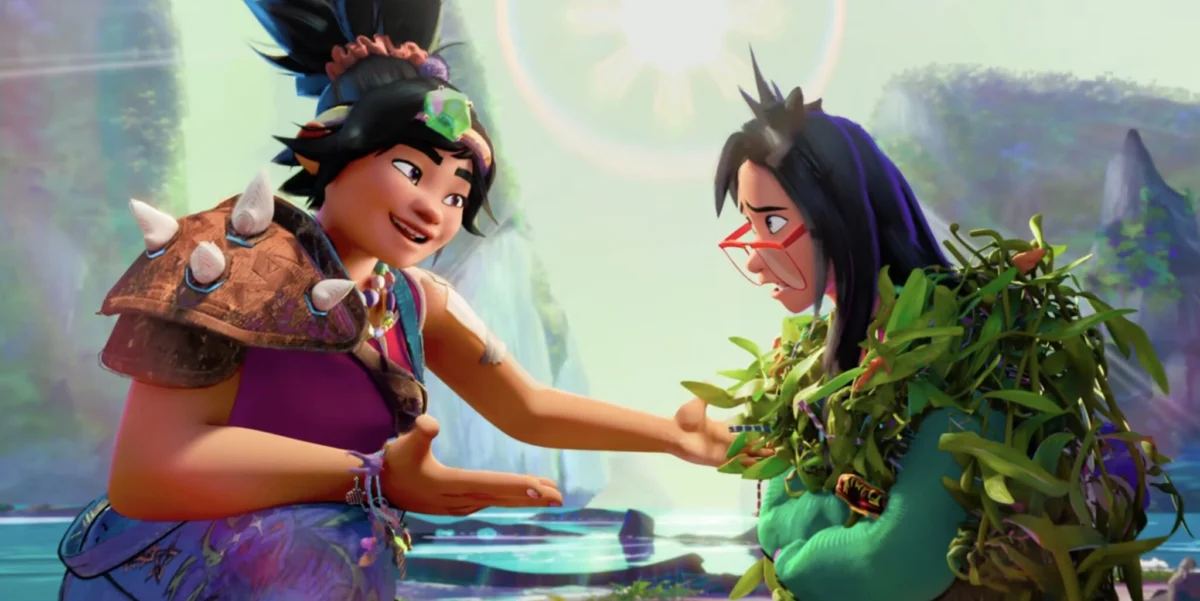
The central plot of Forgotten Island revolves around the lifelong bond between two protagonists, Jo Yuson, voiced by H.E.R., and Raissa Molina, voiced by Liza Soberano. Their friendship is forged in childhood following an incident at school where Jo defends her grandmother’s traditional stories from skeptical classmates, and Raissa intervenes to support Jo against an administrative misunderstanding regarding mythological creatures. The narrative establishes a classic dynamic between contrasting personalities: Jo serves as the adventurous, emotionally driven catalyst, while Raissa acts as her analytical and pragmatic counterpart.

The foundational lore of the story is anchored by Jo’s grandmother, or lola, played by Dolly de Leon, who introduces the characters to the concept of Nakali—a hidden, mystical island where Philippine folklore remains active. As the protagonists transition toward adulthood, external pressures threaten to separate them. Jo faces a period of aimlessness following the death of her grandmother and works as a local commercial mascot, while Raissa prepares to relocate for higher education at the California Institute of Technology (CalTech). A final night of adolescent celebration leads the duo to uncover a physical key granting access to Nakali. However, upon waking on the mythical island, they experience memory loss regarding the preceding evening, and Raissa discovers she has acquired a pair of supernatural wings associated with the Manananggal, a traditional vampire-like entity from Philippine folklore.
Supporting Cast and Mythological Integration
Upon arriving on Nakali, the protagonists encounter a series of figures drawn directly from Philippine folklore and adapted for a family audience. Among them is Raww, a "were-aspin"—a shape-shifting dog creature voiced by Dave Franco—who participated in the previous night’s events. The characters seek assistance from Batiba, an agoraphobic memory demon voiced by Jenny Slate, who demands the memories of Jo and Raissa’s friendship in exchange for passage off the island. Refusing this trade, the protagonists embark on a journey across Nakali to retrace their steps and uncover the events of the lost evening.
The supporting cast also features characters such as Mermahn, a Kataw (mythological sea creature) voiced by Kevin McCann. The integration of these folkloric elements was supported by comprehensive cultural research. Composer Nathan Matthew David traveled to the Philippines to study indigenous musical traditions, integrating authentic acoustic elements into the film’s orchestral score. This dedication to cultural authenticity extends to the characterizations of figures like Manang, the Dreaded Manananggal, voiced by Lea Salonga, whose backstory is handled with narrative restraint to preserve the character’s traditional mystique rather than relying on expositional infodumps.
Industry Context and Critical Reception
Forgotten Island enters a competitive global box office landscape where original animated features face significant pressure to perform against established intellectual properties. Box office tracking and initial critical reception indicate strong word-of-mouth performance, particularly among Millennial audiences who connect with the film’s nostalgic framing of late-20th-century youth culture, as well as younger viewers drawn to its dynamic action sequences and comedic pacing.

Media analysts have observed that the film’s specific focus on the psychological and social realities of girlhood fills a notable gap in contemporary studio animation. While coming-of-age narratives involving male protagonists are historically prevalent, stories examining the complexities, conflicts, and deep fidelities of female friendship remain comparatively rare within high-budget animated cinema. The narrative eventually reveals that Jo engineered the journey to Nakali as a desperate measure to prevent her separation from Raissa, highlighting the emotional stakes of transition periods in young women’s lives.
Cultural Implications and Audience Demographics
The inclusion of non-Western mythologies in major studio releases has occasionally encountered polarized responses within digital spaces. Industry observers note that narratives centering on indigenous folklore and female-centric interpersonal relationships routinely face coordinated online scrutiny from specific demographic segments. However, theater attendance data and critical reviews suggest that such digital discourse has minimal impact on the film’s broader reception, which has been characterized by high engagement across family and adult audiences alike.
The economic and cultural implications of projects like Forgotten Island point toward a diversifying market for major animation studios. By investing in distinct cultural frameworks—such as Philippine mythology—and pairing them with high-production-value visual aesthetics and recognizable voice talent, studios can capture niche international markets while broadening the thematic scope of domestic releases. The film demonstrates that culturally specific storytelling can achieve universal resonance when anchored by strong character relationships and universal emotional truths.
Conclusion and Future Outlook
Forgotten Island stands as a notable entry in DreamWorks Animation’s catalog, demonstrating the studio’s ongoing capacity for inventive storytelling outside of its traditional blockbuster franchises. By wedding fast-paced comedy and anime-inspired action with a respectful exploration of Philippine folklore and the emotional gravity of female adolescence, the creative team has delivered a structurally sound and culturally resonant cinematic experience. As the animation industry continues to navigate shifting audience preferences and global distribution models, the commercial and artistic reception of Forgotten Island offers a compelling indicator of the potential for culturally diverse, original storytelling in the contemporary theatrical market.