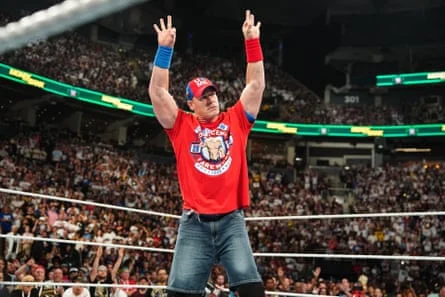
The transition from professional wrestling to mainstream Hollywood has historically yielded mixed results, yet 49-year-old John Cena has carved out a distinct niche that sets him apart from predecessors like Hulk Hogan and Dwayne "The Rock" Johnson. Having recently retired from active professional wrestling following a landmark 24-year career with World Wrestling Entertainment (WWE), Cena now balances a burgeoning filmography—highlighted by his upcoming role in Apple TV’s Matchbox: The Movie—with the complexities of enduring corporate affiliations. His career trajectory offers a fascinating case study in modern brand loyalty, physical performance, and the shifting paradigms of masculinity in contemporary entertainment.
Early Life, Financial Hardship, and the Foundation of Discipline
Born in West Newbury, Massachusetts, in 1977, Cena grew up in a household characterized by financial austerity. Raised alongside four brothers in a tight-knit family environment where his grandparents lived in an adjoining residence, Cena frequently witnessed the economic pressures faced by working-class families during the late 1970s and 1980s. Influenced heavily by the blockbuster action icons of the era, including Arnold Schwarzenegger, Sylvester Stallone, and Bruce Willis, Cena also developed an affinity for hip-hop culture—a choice that in suburban Massachusetts often made him a target for peer hostility.
Rather than succumbing to intimidation, Cena turned to bodybuilding as both a physical deterrent and a personal philosophy. This disciplined approach eventually guided his move to California in 1999. Arriving in Venice Beach with approximately $500, he secured employment on the shop floor of Gold’s Gym for six dollars an hour, temporarily residing in the back of his 1991 Lincoln. Encouraged by fellow wrestlers who frequented the gym, Cena transitioned into the industry, debuting in the World Wrestling Federation (WWF, now WWE) in 2000 as "The Prototype," a robotic persona modeled loosely on his cinematic idols. His initial contract paid $250 a week, plunging him into short-term debt, but the calculated risk laid the groundwork for a historic multi-decade tenure.

The Rise of a WWE Super-Stardom and the Cost of Corporate Identity
Cena’s breakthrough in the WWE occurred when he adopted a persona that closely mirrored his own personality: a jersey-wearing, battle-rapping competitor from Massachusetts. Despite initial skepticism from traditionalist fans regarding his wholesome, clean-living image and friction with peers over his avoidance of the industry’s prevalent heavy-drinking culture, the gimmick resonated widely with the public.
This success, however, came with specific contractual realities. Unlike some modern performers who retain full rights to their intellectual property, Cena does not legally own the trademark to his own name. Under agreements with WWE and parent company TKO Group Holdings, the corporate entity retains the rights to the "John Cena" persona, an arrangement Cena has consistently defended as fair and transparent. Industry analysts note that such relinquishments were standard practice during the height of the Attitude Era, though recent negotiations by figures like Dwayne Johnson—who secured the rights to "The Rock" moniker and a seat on the TKO board in 2024—signal a shift in talent leverage.
Controversies and Corporate Associations
Cena’s steadfast commitment to corporate loyalty has occasionally intersected with broader industry controversies. Most notably, his relationship with Vince McMahon, the former chairman and CEO of WWE, has remained a point of public scrutiny. In January 2024, McMahon resigned from WWE and TKO Group Holdings following severe sexual assault allegations and pending civil litigation, including a federal lawsuit filed by former employee Janel Grant alleging sexual abuse and trafficking within the organization. While McMahon has consistently denied all allegations, and the litigation was subsequently moved to confidential private arbitration, Cena has openly acknowledged his enduring personal gratitude toward McMahon, describing him as a mentor and a foundational figure in his professional life.
Further international complications arose in 2021 during promotional tours for Fast & Furious 9. Cena referred to Taiwan as a country during a Mandarin-language interview, sparking significant backlash from Chinese audiences and state media. To mitigate potential economic fallout for the film franchise and his personal standing, Cena recorded a public apology in Mandarin. The incident drew widespread criticism in Western media, where commentators interpreted the apology as capitulation to international market pressures. Reflecting on the episode, Cena has since acknowledged that his overconfidence in linguistic proficiency outpaced his cultural awareness, highlighting the precarious balance international celebrities maintain when navigating geopolitical sensitivities.
Transition to Hollywood and Redefining Masculinity
While Cena’s early cinematic roles—such as his title debut in The Marine (2006)—typecast him in rigid action vehicles, his career experienced a transformative pivot when he began embracing comedic subversion. His breakthrough performance in Judd Apatow’s 2015 romantic comedy Trainwreck showcased an ability to satirize hyper-masculinity. This self-awareness carried into subsequent high-profile projects, including his portrayal of Peacemaker in James Gunn’s The Suicide Squad (2021) and the subsequent HBO Max spin-off series, as well as a memorable, self-effacing cameo as a merman in Greta Gerwig’s Barbie (2023).
Media analysts have noted that Cena’s onscreen persona offers a distinct alternative to the joyless, aggressive archetypes frequently promoted by online commentators and certain public figures. By combining physical imposingness with vulnerability and comedic timing, Cena has cultivated a cross-generational appeal. Yet, the actor remains hesitant to position himself as a cultural spokesperson for modern manhood, citing the volatile nature of public movements and the primacy of personal authenticity.
Philanthropy and Personal Life
Outside of entertainment, Cena maintains a legacy of unprecedented philanthropic engagement, most notably through his work with the Make-A-Wish Foundation. Having granted more than 650 individual wishes—surpassing any other living individual—Cena attributes his capacity for extensive charity work in part to his decision to remain child-free. Having openly discussed the demands of a career that historically kept him away from home for more than 300 days a year, Cena married Iranian-Canadian tech product manager Shay Shariatzadeh in 2020 following previous high-profile relationships.
Future Outlook and Ongoing Projects
As Cena transitions into his post-wrestling era, his professional slate continues to expand. Following the release of Matchbox: The Movie on Apple TV, he is slated to star in One Attempt Remaining, a comedy directed by Kay Cannon centered on a divorced couple recovering a lost cryptocurrency password.
Industry observers suggest that Cena will likely remain permanently linked to the WWE brand, serving in ambassadorial capacities while continuing to test the boundaries of action-comedy cinema. Rather than shedding his corporate roots, Cena’s career demonstrates how absolute dedication to a chosen path can redefine celebrity longevity in the twenty-first century media landscape.