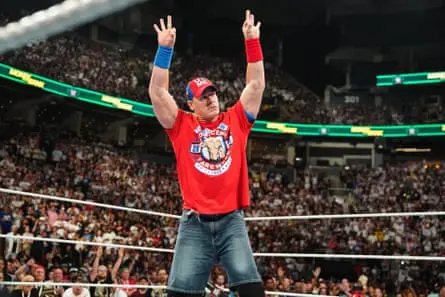
The transition from professional sports entertainment to mainstream Hollywood superstardom has historically been fraught with creative and personal challenges. Few figures have navigated this dual trajectory with the sustained cultural impact of John Cena. Having recently concluded a landmark 26-year career with World Wrestling Entertainment (WWE), Cena has carved out an enviable cinematic niche, effortlessly pivoting from playing well-meaning dimwits in high-concept comedies to complex, self-aware action antiheroes. However, as Cena steps into his latest high-profile role—starring in Apple TV’s forthcoming adaptation Matchbox: The Movie—his enduring allegiance to the institutions that shaped him continues to draw intense public scrutiny, highlighting the complex relationship between personal integrity and corporate loyalty in modern entertainment.
From Humble Beginnings to WWE Stardom: The Chronology of an Icon
Born in West Newbury, Massachusetts, in 1977, Cena’s formative years were defined by financial precarity. Raised in a household of five boys alongside his grandparents in an adjoining residence, Cena experienced firsthand the daily stresses of maintaining household finances. Drawing inspiration from the dominant action cinematic figures of the 1980s—including Arnold Schwarzenegger, Sylvester Stallone, and Bruce Willis—Cena found solace and a physical outlet in bodybuilding, a pursuit that would eventually serve as his primary vehicle for social survival.
In 1999, armed with approximately $500 and heavily influenced by Schwarzenegger’s autobiographical blueprint for success, Cena drove to California. He secured employment on the shop floor at Gold’s Gym in Venice Beach, earning six dollars an hour, and temporarily lived out of the back of his 1991 Lincoln Town Car. Mentored by fellow wrestlers training at the facility, Cena entered the professional wrestling circuit, making his debut in 2000 under the World Wrestling Federation (now WWE) banner as "The Prototype."

Initially earning a modest $250 a week, Cena plunged into short-term financial debt before hitting his stride. By the early 2000s, he successfully launched a breakthrough persona: a jersey-wearing, battle-rapping white hip-hop enthusiast from suburban Massachusetts who performed under his real name. Despite initial skepticism from traditional wrestling fans and peers who ostracized him for rejecting the heavy-drinking culture pervasive in the industry at the time, the gimmick resonated widely, anchoring WWE programming through a transformative cultural era.
Corporate Alliances and the Shadow of Vince McMahon
Cena’s career has been steadfastly defined by an unwavering sense of corporate loyalty. Throughout his tenure, he frequently utilized the term "service" to describe his relationship with WWE, emphasizing authenticity within an industry built on theatrical spectacle. However, this profound loyalty has occasionally placed him at the center of profound industry controversies.
The most prominent test of Cena’s corporate allegiance occurred in January 2024, when Vince McMahon, the long-serving chairman and CEO of WWE and its parent company TKO Group Holdings, resigned following a series of severe sexual assault allegations and pending federal lawsuits. The catalyst was a legal filing by former WWE employee Janel Grant, alleging that McMahon subjected her to sexual assault, forced sexual acts, shared explicit imagery without consent, and used her to secure talent acquisitions. McMahon has consistently denied all allegations. In June 2024, all parties voluntarily transferred the litigation to confidential private arbitration.
Despite the gravity of the allegations and McMahon’s subsequent disgrace, Cena has publicly defended his relationship with his former mentor. In media appearances surrounding his promotional obligations, Cena stated that he harbors "no guilt nor shame" regarding his friendship with McMahon, framing his stance as an exercise in maintaining personal principles during turbulent times and asserting that it is acceptable to care for individuals who are imperfect.

The Global Scale and Economic Realities of the Brand
Cena’s career trajectory also underscores the intricate financial agreements governing modern sports entertainment intellectual property. Unlike traditional actors who retain ownership of their names and likenesses, Cena’s professional identity remains tied to corporate enterprise. Under his contractual agreements with WWE and TKO Group Holdings, the corporate entity maintains significant ownership of the intellectual property rights associated with the name "John Cena." Analysts note that this corporate framework is standard within the industry, comparable to Dwayne "The Rock" Johnson, who only secured full ownership rights to his moniker and catchphrases in 2024 prior to joining the TKO board of directors.
Furthermore, Cena’s international promotional efforts have occasionally generated geopolitical friction. In 2021, while promoting Fast & Furious 9, Cena referred to Taiwan as a country during a Mandarin-language promotional interview—a language he studied for six years to expand WWE’s market footprint in East Asia. The remark sparked immediate backlash among audiences in mainland China, prompting Cena to release a public apology in Mandarin. The video drew widespread criticism in Western media as corporate capitulation to foreign economic influence. Reflecting on the incident, Cena acknowledged that his overconfidence and cultural miscalculation nearly jeopardized his career within an organization to which he remains deeply devoted. Similarly, his continued participation in WWE-sponsored events in Saudi Arabia has drawn scrutiny, though Cena maintains that the organization serves as a universal platform for cultural diplomacy.
Hollywood Evolution and the Redefinition of Masculinity
Away from the wrestling ring, Cena has systematically dismantled the rigid tropes of hyper-masculinity that dominated media landscapes in the post-9/11 era. After initial struggles in traditional action films, his comedic breakthrough arrived in Judd Apatow’s 2015 romantic comedy Trainwreck, where he portrayed a muscular yet emotionally vulnerable partner.
This self-aware subversion of the action-hero archetype solidified with his portrayal of Peacemaker in James Gunn’s The Suicide Squad (2021) and the subsequent HBO Max spin-off series. Despite resistance from talent agents who advised against taking small supporting roles, Cena famously accepted a cameo as a merman in Greta Gerwig’s critically acclaimed Barbie (2023), further establishing his penchant for self-deprecating comedy.
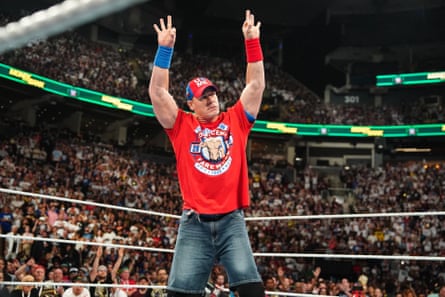
Cinematic analysts suggest that Cena’s onscreen persona offers a refreshing alternative to the grievance-driven online figures currently dominating public discourse. Yet, Cena explicitly rejects the mantle of cultural spokesman for modern manhood. He attributes his public appeal to basic economic supply and demand rather than intentional social engineering, maintaining a disciplined lifestyle that prioritizes professional focus over personal expansion. Notably, Cena has chosen not to have children, citing the extreme time demands of his career—which saw him spending as few as 15 days a year at home during the peak of his wrestling tenure—as incompatible with responsible fatherhood.
Philanthropic Impact and Future Outlook
Despite his demanding production schedule, Cena holds a historic philanthropic record, having fulfilled more than 650 wishes through the Make-a-Wish Foundation, making him the most prolific grantor of wishes in the organization’s history. He attributes his ability to maintain this level of charitable output directly to his decision to remain child-free, allowing him to dedicate vast resources to public service.
As Cena prepares for the October 9 release of Matchbox: The Movie on Apple TV—in which he stars as Sean, an undercover operative whose life is defined by constant performance—and looks ahead to his upcoming comedy One Attempt Remaining, his legacy remains unique. Rather than completely separating himself from his wrestling origins, Cena has embraced his identity as a consummate professional: disciplined, punctual, and inextricably linked to the corporate machinery that launched him to global prominence.