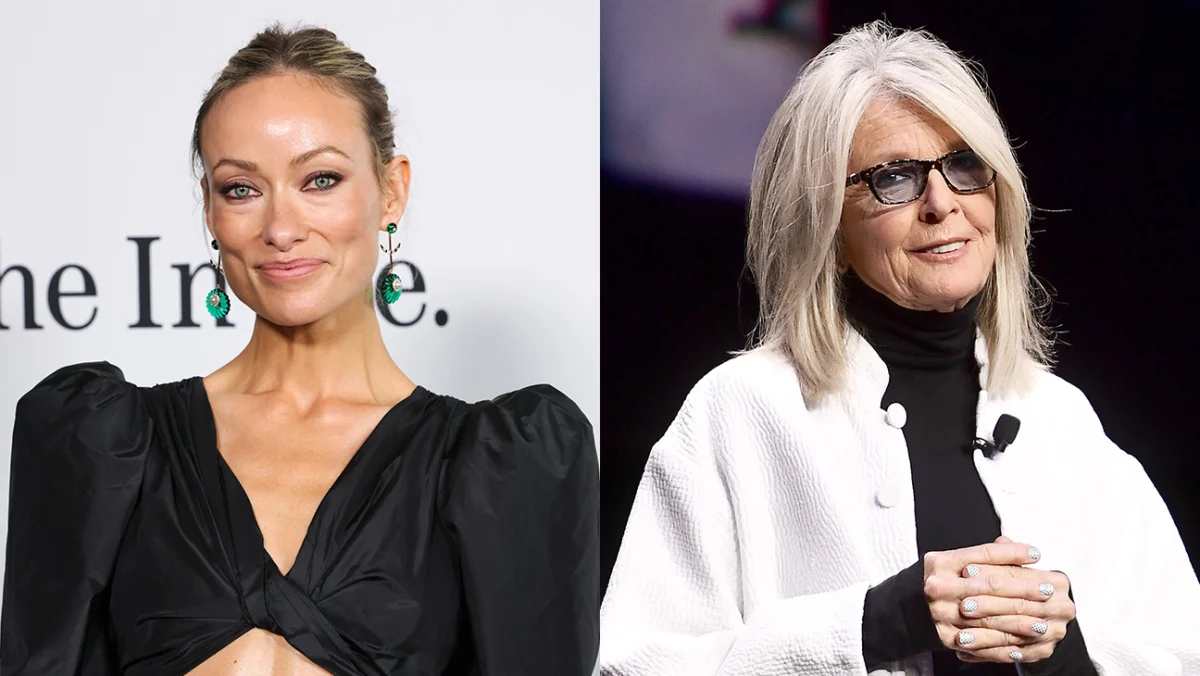
Olivia Wilde’s latest directorial and starring endeavor, The Invite, concludes with a poignant, minimalist dedication before the credits roll: a simple on-screen note that reads, "For Diane." This heartfelt tribute is directed at the legendary actress Diane Keaton, a figure Wilde unequivocally cites as a foundational inspiration for her filmmaking journey and a personal mentor. The dedication serves to underscore Keaton’s significant and lasting impact on Wilde’s artistic vision, particularly in the nuanced crafting of complex female characters and the pursuit of narrative depth in her work.
The Genesis of a Dedication: Wilde’s Admiration for Keaton
At the Los Angeles premiere of The Invite, Olivia Wilde elaborated on the profound significance of this dedication, sharing her admiration for Keaton with The Hollywood Reporter. "I really wanted to show this movie to Diane. I don’t think that there is an Invite without Diane Keaton because she’s in so many of the films that inspired this film," Wilde stated. Her words reveal a deep respect for Keaton’s filmography and its direct influence on the thematic and stylistic choices within The Invite.
Wilde further articulated what makes Keaton such a unique and inspiring figure in cinema. "She is the first actress I recognized to kind of represent a totally unique and complex woman; she didn’t fit any archetype, she was singular in her vulnerability, her complexity, her creativity. She’s unlike anyone else and she was very encouraging to me personally, and I just wanted this to be for her." This statement highlights Keaton’s pioneering spirit in portraying women on screen who defied conventional molds, embracing flaws, intelligence, and individuality. For Wilde, Keaton’s ability to embody such multifaceted characters served as a beacon, guiding her own approach to storytelling, especially in a film like The Invite which delves into the intricate and often messy realities of human relationships. The personal encouragement Wilde received from Keaton further cements the bond between the two artists, making the dedication a deeply personal gesture of gratitude and reverence.
A Shared Professional Journey and Mentorship
The connection between Olivia Wilde and Diane Keaton extends beyond shared cinematic sensibilities, encompassing a tangible professional collaboration. The two actresses worked together on the 2015 comedy Love the Coopers, where Keaton portrayed Wilde’s mother. This on-set experience provided Wilde with firsthand insight into Keaton’s working style and personal ethos, solidifying her admiration.
Wilde has frequently spoken about Keaton’s mentorship, often recalling anecdotes that illustrate Keaton’s generous and spirited nature. In a past tribute shared on Instagram, Wilde reminisced about their time together, detailing how Keaton "laughed through night shoots, kept us roaring with laughter constantly actually, and talked to us for hours about love. She told me to keep my heart open. She told me to direct. She told me to be brave. She told me to keep laughing." This snapshot of their interactions paints a vivid picture of Keaton as not just an acting legend, but a genuine mentor who imparted invaluable life and career advice. The counsel to "direct" clearly resonated with Wilde, who has since transitioned successfully into a significant career behind the camera. This profound personal and professional relationship forms the bedrock of the dedication, transforming it from a mere name into a meaningful acknowledgement of a guiding light.
Diane Keaton: A Cinematic Legacy of Authenticity and Innovation
Diane Keaton’s career, spanning over five decades, is a testament to her unique talent and her profound impact on Hollywood. Born in 1946, Keaton rose to prominence in the 1970s, quickly establishing herself as an actress who eschewed traditional leading lady roles in favor of characters imbued with intelligence, wit, and a distinct quirkiness.
Her early career saw significant collaborations with director Woody Allen, which proved pivotal in shaping her public persona and artistic trajectory. After her Broadway debut in Hair, Keaton made her film debut in Lovers and Other Strangers (1970) before appearing in Allen’s Play It Again, Sam (1972). However, it was her role as Kay Adams-Corleone in Francis Ford Coppola’s seminal crime epic The Godfather (1972) and its sequel The Godfather Part II (1974) that brought her widespread recognition, showcasing her ability to hold her own amidst an ensemble of powerful male actors.
The turning point in her career, and perhaps her most iconic role, came with Annie Hall (1977), directed by Woody Allen. Keaton’s portrayal of Annie Hall, a free-spirited and unconventional aspiring singer, earned her an Academy Award for Best Actress. The film itself redefined the romantic comedy genre, offering a more intellectual, self-aware, and emotionally complex narrative than previously seen. Keaton’s distinctive fashion sense in the film – oversized blazers, vests, and wide-leg trousers – became a cultural phenomenon, influencing fashion trends for years and cementing her status as a style icon. More importantly, Annie Hall as a character represented a new kind of female protagonist: intelligent, independent, vulnerable, and perfectly imperfect, a direct precursor to the "unique and complex woman" Olivia Wilde so admires.
Beyond her work with Allen, Keaton demonstrated remarkable versatility. She garnered another Oscar nomination for her dramatic role as Louise Bryant in Warren Beatty’s historical epic Reds (1981). Throughout the 1980s and 1990s, she continued to deliver memorable performances in films such as Baby Boom (1987), Father of the Bride (1991), and Marvin’s Room (1996), for which she received her third Academy Award nomination.
Her career experienced a resurgence in the early 2000s, particularly with Something’s Gotta Give (2003), where she starred opposite Jack Nicholson. This romantic comedy explored themes of love and aging in a mature and humorous way, earning Keaton her fourth Oscar nomination and proving her enduring appeal as a leading lady well into her fifties. She continued to captivate audiences in films like The First Wives Club (1996), Because I Said So (2007), and Poms (2019), consistently choosing roles that allowed her to portray strong, relatable, and often unconventional women.
Diane Keaton’s legacy is defined by her unwavering commitment to authenticity and her pioneering spirit. She carved a niche for herself by playing characters who were intelligent, often neurotic, and always deeply human. This approach redefined what a leading lady could be, moving beyond glamorous archetypes to embrace genuine complexity. Her influence is palpable in generations of actresses and filmmakers, including Olivia Wilde, who seek to tell stories about women who are real, flawed, and utterly compelling.
"The Invite": An Intimate Exploration of Relationships
The Invite itself, the film carrying this significant dedication, is an intimate character study that delves into the fragile dynamics of a modern marriage. The narrative centers on a couple barely managing to keep their relationship afloat, who decide to host their neighbors for what quickly devolves into a surprisingly revealing dinner party. The film promises an exploration of unspoken tensions, societal expectations, and the raw vulnerability inherent in long-term partnerships.
This project marks Olivia Wilde’s third feature film as a director, following the critically acclaimed coming-of-age comedy Booksmart (2019) and the psychological thriller Don’t Worry Darling (2022). Each of Wilde’s directorial efforts has showcased her evolving vision and her willingness to tackle diverse genres and thematic challenges. While Booksmart was lauded for its fresh take on female friendship and teen experiences, and Don’t Worry Darling sparked considerable public discourse, The Invite appears to represent a return to a more contained, character-driven narrative, allowing Wilde to focus on the subtleties of human interaction.
Wilde also stars in The Invite alongside Seth Rogen, portraying the couple in crisis. Their chemistry and dramatic interplay are central to the film’s premise. They are joined by a formidable ensemble cast, with Penélope Cruz and Edward Norton playing their intriguing neighbors. This quartet of accomplished actors promises a powerful and nuanced exploration of the film’s themes.
The screenplay for The Invite was adapted from the 2020 Spanish-language film The People Upstairs. The adaptation process was helmed by writers Rashida Jones and Will McCormack, who collaborated closely with Wilde to reimagine the story for an English-speaking audience while retaining its core emotional resonance. McCormack noted, "We didn’t want to reinvent the wheel, we love the Spanish film. I think the ending was something we really focused on from the jump, that was something we gave the most attention to. And with any movie with relationships, we’re trying to figure out why they fell in love, how they fell in love, are they still in love and if they’ll remain together and just really digging into that and just making sure that all worked.” This focus on the fundamental questions of love and partnership underscores the film’s ambition to create a deeply empathetic and psychologically rich narrative.
The Craft of Filmmaking: Wilde’s Collaborative Approach
Beyond its compelling narrative, The Invite stands out for Olivia Wilde’s deliberate and deeply collaborative approach to its production. Wilde articulated her "dream production" process, which she was able to fully realize on this project. "This project gave me the opportunity to approach a production in a way that I’d always dreamed," Wilde explained. "I wanted to really workshop material together, I wanted to feel real collaboration, I wanted to rehearse, I wanted to shoot on film, and because of the logistical reality of this film being in one location, we could also shoot in order, which was something that I always dreamt of. I thought, ‘Wow, we can approach it like a play.’ So it was a film that allowed for a process that was so singular, and I just thought, ‘That’s what I want.’ I want to make something because of the process and not the imagined result.”
This methodology stands in contrast to the more conventional, often fragmented, production schedules of many contemporary films. Shooting on film, a choice increasingly rare in the digital age, lends a particular aesthetic quality and texture to the visual storytelling, often favored for its depth and classic cinematic feel. The decision to shoot in chronological order, akin to a theatrical play, allowed the actors and crew to experience the narrative progression organically. This could significantly deepen performances, enabling the actors to build their characters’ emotional arcs sequentially and respond authentically to the evolving story.
The extensive rehearsal period further exemplifies Wilde’s commitment to collaboration. Writers Rashida Jones and Will McCormack were integral to this process, actively participating in brainstorming sessions with the cast and director. This allowed for real-time script adjustments and character development, ensuring that the dialogue and emotional beats were finely tuned and authentic. This intensive, workshop-style approach aimed to delve deeper into the characters’ motivations and complexities, enhancing the psychological realism of the film. Such a process, prioritizing artistic exploration and collective input, reflects a dedication to craft that resonates with the kind of thoughtful filmmaking Wilde admires in artists like Diane Keaton.
Olivia Wilde’s Evolving Career Trajectory
Olivia Wilde’s journey from acclaimed actress to a respected auteur has been marked by a clear artistic vision and a willingness to challenge herself. After a successful acting career in television (e.g., House) and film (TRON: Legacy, Rush), Wilde made a decisive pivot to directing. Her directorial debut, Booksmart (2019), was a critical darling, praised for its fresh perspective on female friendship, sharp humor, and strong performances. It firmly established her as a director with a distinct voice.
Her sophomore effort, Don’t Worry Darling (2022), was a larger-scale studio production that garnered significant media attention, both for its intriguing premise and the widely reported behind-the-scenes dynamics. While the film had a strong box office performance, its critical reception was more mixed. With The Invite, Wilde appears to have strategically chosen a project that allows her to return to a more independent, process-driven filmmaking style. This choice aligns with her stated artistic goals of prioritizing genuine collaboration and the journey of creation over solely focusing on commercial outcomes. The Invite positions her as a filmmaker continually refining her craft and exploring diverse narratives, demonstrating a maturity in her directorial choices.
Broader Cinematic Context and Implications
The dedication of The Invite to Diane Keaton is more than a personal gesture; it is a meaningful act within the broader cinematic landscape. It highlights the tradition of filmmakers paying homage to their influences, strengthening the lineage of artistic inspiration across generations. In an industry often fixated on novelty, acknowledging the foundational figures who shaped contemporary storytelling is crucial.
Wilde, through her own work and her outspoken admiration for Keaton, contributes significantly to the evolving narrative of female storytellers in Hollywood. Keaton’s groundbreaking portrayals of independent, intelligent women undoubtedly paved the way for directors like Wilde to explore similar themes and characters with greater freedom and depth. This dedication underscores the ongoing importance of diverse female voices both in front of and behind the camera, driving narratives that resonate with a wider audience.
Furthermore, The Invite‘s production philosophy—emphasizing shooting on film, extensive rehearsals, and a collaborative workshop environment—reflects a commitment to craft often associated with independent cinema, even with the involvement of recognizable stars. In an era dominated by large franchises and CGI-heavy blockbusters, films like The Invite demonstrate the enduring appeal and artistic vitality of intimate, character-driven dramas. They remind audiences and filmmakers alike of the power of nuanced storytelling and authentic human connection.
Release and Anticipation
The Invite is set to make its debut in select theaters on Friday, with a wider release scheduled for July 10. The dedication to Diane Keaton, coupled with Wilde’s distinctive directorial style and the film’s compelling premise, is likely to generate significant interest. As audiences prepare to experience The Invite, the silent "For Diane" at its conclusion will serve as a powerful reminder of the enduring legacy of a cinematic icon and the profound impact she continues to have on contemporary filmmakers shaping the future of storytelling.