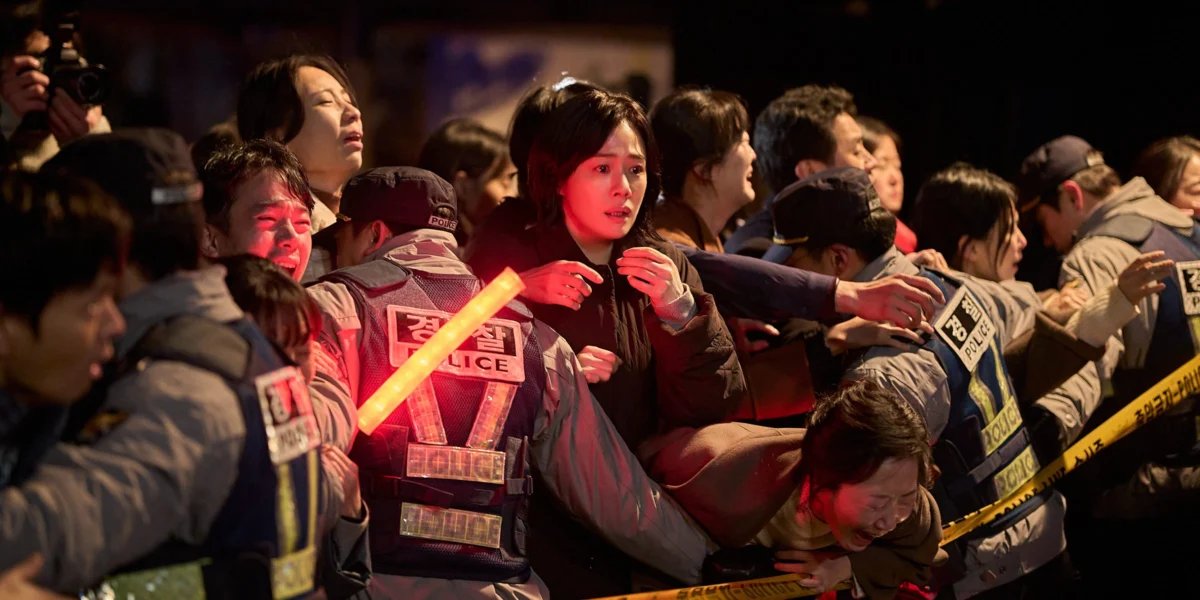
The 101-minute psychological thriller Paradise Lost, directed and written by Yeon Sang-ho alongside co-writer Ryu Yong-jae, made its premiere at the Toronto International Film Festival (TIFF) to critical intrigue. Starring Kim Hyun-joo and Bae Hyeon-seong, the feature-length film shifts Yeon’s signature exploration of humanity pushed to its absolute limits away from supernatural outbreaks and into the chilling, plausible realities of artificial intelligence and unresolved trauma. Rather than relying on the viral collapses and societal disintegrations depicted in his previous works such as Train to Busan and Colony, Yeon constructs a narrative rooted in a mother’s enduring grief, the predatory commercialization of bereavement, and the harrowing return of a child long presumed dead.
Main Facts and Narrative Premise
The core narrative of Paradise Lost centers upon Ryu So-young, portrayed by Kim Hyun-joo, whose son, Ryu Sun-woo (played by Bae Hyeon-seong), was abducted nine years prior during a school camping trip. The incident involved a bus carrying thirteen children that vanished near the region of Musan. For nearly a decade, So-young has lived in the suspended animation of unresolved loss, a psychological state exploited by Transhuman, a technology corporation offering virtual reality software titled Children of Paradise. This program reconstructs missing children using data compiled from parental photographs, home videos, and recorded interviews, creating a synthetic simulation that allows grieving parents to interact daily with digital avatars of their lost offspring.
The film’s trajectory fractures when a DNA test confirms that a young man found in Musan is indeed Sun-woo, who has miraculously returned alive. However, his repatriation fails to deliver closure. Instead, So-young finds herself forced to navigate an impossible psychological landscape: competing with the ten-year-old digital apparition she has interacted with every morning for nine years while simultaneously confronting a living son who has been fundamentally altered, harboring dark secrets and displaying a chilling detachment.
Chronology and Narrative Background
The timeline of Paradise Lost unfolds across two distinct temporal planes: the traumatic inciting incident from nine years prior and the contemporary reality of the film’s events.
Phase One: The Musan Disappearance
Nine years before the primary events of the film, a school camping bus carrying thirteen children disappears without a trace outside the rural district of Musan. Despite immediate mobilization, the initial manhunt yields few results beyond a vanishing driver and sparse security footage capturing the vehicle’s last known sightings.
Phase Two: The Mine Collapse and Media Spectacle
The search efforts ultimately stall following the discovery of six bodies. Operations are permanently suspended when the local mine shaft—suspected of holding further evidence—experiences a catastrophic structural collapse. This phase establishes the media circus surrounding parental grief, anchoring the audience in So-young’s desperate extraction from the mine site, physically and emotionally broken.
Phase Three: The Transhuman Era
In the years following the halted investigation, Transhuman steps into the vacuum of unresolved grief. The introduction of the Children of Paradise VR system institutionalizes mourning. So-young adopts a strict daily routine, donning VR glasses every morning to eat breakfast across from a static, ten-year-old digital manifestation of Sun-woo.
Phase Four: The Impending Redevelopment
The routine is forcibly disrupted when municipal authorities announce the impending redevelopment of the Musan mine, setting a strict one-month deadline before heavy construction obliterates the site permanently. City officials present So-young with the key to the mine, framing it as her final opportunity to attain closure.
Phase Five: The Return and Escalation
Moments after this symbolic gesture of acceptance, So-young is summoned to the Musan police station. DNA profiling confirms that a newly discovered young man is her biological son, Sun-woo. As he integrates back into her life, the narrative pivots sharply into thriller territory. A persistent investigative reporter tracks Sun-woo, uncovering a trail of violence and hidden truths regarding the horrific conditions he endured during his nine-year absence.
Supporting Data and Production Details
Paradise Lost operates with a tight runtime of 101 minutes, utilizing structural efficiency to build psychological tension. The production design deliberately contrasts sterile technological aesthetics with the decaying, oppressive atmosphere of rural Musan.
- Paradise Lost
- Format: Feature-length psychological thriller film
- Running Time: 101 minutes
- Cast: Kim Hyun-joo (Ryu So-young), Bae Hyeon-seong (Ryu Sun-woo)
- Director / Writer: Yeon Sang-ho
- Co-Writer: Ryu Yong-jae
- Key Technology Featured: Children of Paradise (Virtual Reality simulation software developed by Transhuman)
- Primary Locations: Musan district, abandoned mine shafts, municipal offices, and police precincts.
Cinematically, the film opens using a true-crime documentary aesthetic, incorporating simulated news broadcasts, grainy security footage, and procedural narration to ground the fictional tragedy in a hyper-realistic framework. This documentary framing underscores the systemic monetization of public tragedy.
Official Responses and Thematic Implications
While Paradise Lost is a fictional work, its release at TIFF has prompted industry-wide discussions regarding the intersection of artificial intelligence, digital legacy, and psychological exploitation. Analysts and critics have drawn parallels to real-world advancements in generative AI, synthetic media, and grief-tech startups that utilize deep learning models to replicate deceased or missing individuals.
In the context of the film’s universe, the fictional corporation Transhuman serves as a direct commentary on late-stage capitalism’s encroachment into the most intimate realms of human suffering. The company’s marketing strategy—presented through infomercials featuring somber musical scores and emotional testimonials—normalizes the commercialization of artificial resurrection.
From a thematic standpoint, Yeon Sang-ho utilizes this premise to dissect the anatomy of loss. In statements surrounding his filmography, Yeon has consistently examined how societal structures fracture under extreme pressure. In Paradise Lost, the pressure is internal and technological. The narrative posits that grief cannot be engineered, cured, or patched over by algorithms.
The juxtaposition between the AI Sun-woo—programmed to display perpetual warmth, dependence, and emotional validation—and the biological Sun-woo—who is traumatized, unreadable, and potentially dangerous—highlights a profound philosophical inquiry: Is an artificial construct capable of generating authentic human connection, and can a biological survivor ever reclaim the innocence stripped away by prolonged trauma?
Broader Impact and Industry Analysis
Paradise Lost marks a notable maturation in Yeon Sang-ho’s directorial style. By scaling down the apocalyptic destruction of his previous blockbusters in favor of an intimate, claustrophobic character study, Yeon demonstrates the versatility of contemporary South Korean cinema in addressing modern technological anxieties.
The film’s reception at the Toronto International Film Festival signals a growing global appetite for narratives that interrogate the ethical boundaries of artificial intelligence. As generative technologies advance rapidly in the real world, cinematic explorations like Paradise Lost provide a critical cultural mirror, reflecting societal fears surrounding authenticity, memory manipulation, and the commodification of human emotion.
Ultimately, the film refuses to offer comforting resolutions. By leaving the ultimate nature of the digital avatar and the true extent of the biological son’s trauma ambiguous, Paradise Lost challenges audiences to confront the uncomfortable reality that some voids cannot be filled, and some losses remain absolute, defying both science and sentimentality.