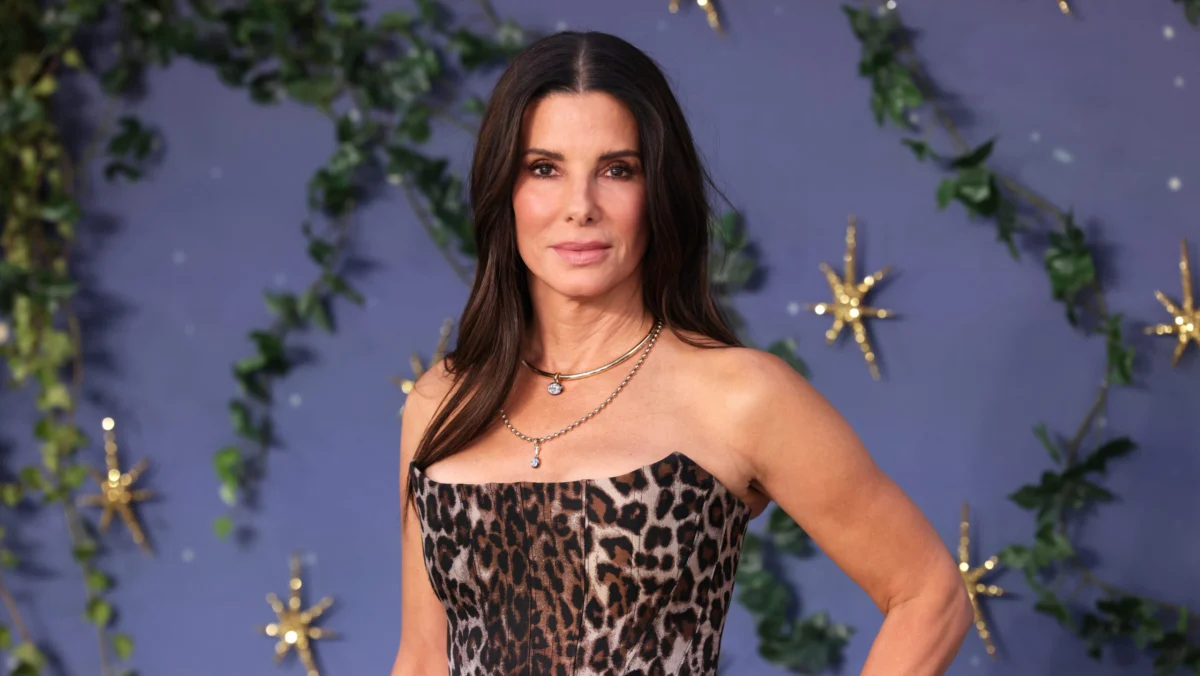
The landscape of the entertainment industry has undergone seismic shifts since the early 1990s, yet few stars have navigated the transition from struggling newcomer to A-list icon with as much scrutiny and success as Sandra Bullock. In a recent, wide-ranging feature for Interview magazine, Bullock sat down with long-time friend and colleague Jennifer Aniston to discuss the arc of her three-decade career, the pressures of fame, and the deliberate, often difficult choices she made to maintain her personal integrity while building a cinematic legacy.
The conversation, which serves as the cover story for the magazine’s latest issue, arrives at a pivotal moment in Bullock’s career as she returns to the spotlight for the highly anticipated sequel, Practical Magic 2. The discussion offered a rare, unvarnished look at the early days of her journey, when the industry was far less regulated and the power dynamics between casting directors and young actresses were frequently exploitative.
The Early Struggles and the Price of Ambition
Long before she was a household name or an Academy Award winner, Bullock was a young actress navigating the grueling audition circuit in New York City. During the interview, Aniston posed a question regarding the nature of Bullock’s career path: was it a byproduct of organic evolution, or a series of calculated, deliberate maneuvers?
Bullock’s response provided a stark reminder of the realities faced by working actors in the late 1980s and early 1990s. She recalled a period marked by precarious financial stability and degrading professional environments. "I was auditioning for every pervert that existed, asking me to drop my pants," Bullock admitted. "I was like, ‘Nope, not the role for me.’"
These revelations highlight a systemic issue that has historically plagued Hollywood, where young talent often felt compelled to compromise their dignity to secure entry-level roles. Bullock’s refusal to participate in such demeaning practices speaks to a foundational boundary-setting that likely contributed to her longevity. She acknowledged the universal anxiety shared by actors of that era, noting that the fear of never working again often forced individuals to accept compromising situations. By choosing to walk away, Bullock established a standard for her career that prioritized professional self-respect over immediate gain.
A Pivot Toward Dramatic Legitimacy
While her early career was defined by survival, Bullock’s mid-career trajectory was defined by a bold, intentional pivot. Having established herself as a formidable talent in the romantic comedy genre—a category that brought her massive commercial success but also a degree of critical pigeonholing—Bullock reached a point where she felt the need to reclaim her narrative.
"The only time I was intentional about my career was when I said, ‘I need to stop right now with the rom-coms,’" she told Aniston. At the time, the actress faced persistent criticism, with some corners of the industry and media suggesting she lacked the range for more serious, dramatic work. Driven by a desire to prove her capabilities, she made the calculated decision to accept a role in Paul Haggis’s 2004 ensemble drama, Crash.
The film was a risky proposition, but it proved to be a masterstroke. Crash went on to win the Academy Award for Best Picture in 2006, signaling to the industry that Bullock was a versatile performer capable of anchoring heavy, narrative-driven projects. This shift paved the way for her 2010 Academy Award-winning performance as Leigh Anne Tuohy in The Blind Side, which solidified her status as a premier dramatic actress. Her career history serves as a blueprint for long-term survival in Hollywood: the ability to identify when one’s current trajectory is becoming a cage and the courage to break out of it.
The Return: Practical Magic 2 and Modern Reception
After a four-year hiatus from the screen, following her performance in the 2022 action-comedy The Lost City alongside Channing Tatum, Bullock has returned to the franchise that cemented her cult-classic status. Practical Magic 2, which hit theaters this past Friday, is being framed by the actress as a "love letter" to her daughter, marking a shift in her professional motivations toward projects that resonate on a personal and familial level.
The film’s performance at the box office suggests that her audience has remained remarkably loyal. On its opening day, including Thursday previews, the film grossed $13 million domestically. Industry analysts project an opening weekend total hovering near the $30 million mark, a strong figure for a sequel arriving more than 25 years after the original.
This success underscores the enduring nature of Bullock’s "star power," a metric that is increasingly difficult to maintain in an era dominated by intellectual property and franchise fatigue. Bullock’s return is not merely a commercial event but a cultural one, demonstrating that an actor’s reputation, built on decades of intentional choices, remains a primary driver for audience engagement.
Contextualizing the Industry Evolution
To understand the weight of Bullock’s early experiences, one must look at the structural changes in the entertainment industry over the past 30 years. The mid-1990s and early 2000s were periods of significant transition for labor practices in Hollywood. The rise of the #MeToo movement in 2017 acted as a catalyst for systemic reform, bringing to light the very "perverts" and power imbalances that Bullock alluded to in her conversation with Aniston.
While Bullock’s early career predated the widespread accountability measures now in place, her experience reflects the quiet, internal battles fought by many women in the industry who operated under the radar of public awareness. By speaking out now, she adds her voice to a growing body of testimony that serves to educate younger generations of actors on the importance of maintaining autonomy.
Furthermore, the data surrounding her career trajectory highlights the economic viability of artistic growth. By shifting from the high-grossing, low-prestige rom-com genre to the high-prestige, medium-budget dramatic sphere, Bullock effectively doubled her marketability. According to historical box office tracking, her films have consistently outperformed standard industry benchmarks for ROI (Return on Investment), cementing her position as one of the most bankable stars of the 21st century.
The Philosophical Implications of Longevity
The conversation between Bullock and Aniston also touched upon the broader challenge of navigating life in the public eye. Both actresses represent a generation of performers who rose to fame before the advent of social media, allowing them to maintain a degree of mystery that is largely unattainable for contemporary stars.
Bullock’s emphasis on "intentionality" serves as a central theme for her ongoing relevance. Her career is a testament to the fact that longevity is not merely a matter of talent, but of strategic positioning. By curating her roles to align with her personal values—such as her focus on motherhood and her desire for creative challenge—she has managed to avoid the burnout that often sidelines high-profile actors.
As she moves forward with projects like Practical Magic 2, the implications for the industry are clear: audiences value authenticity. Bullock’s ability to pivot from a struggling waitress in New York to an Academy Award-winning global icon, all while refusing to participate in the dehumanizing aspects of the audition process, provides a compelling narrative of agency.
In the final analysis, the interview serves as more than just promotional material for her latest film. It is a historical record of an industry in flux and a portrait of a woman who, through a series of deliberate choices, managed to preserve her integrity while ascending to the pinnacle of her profession. For students of film history and aspiring performers alike, Bullock’s journey remains a quintessential case study in how to survive, evolve, and ultimately thrive in an often unforgiving environment. As the box office numbers for her latest venture continue to climb, it is evident that her audience remains as invested in her choices today as they were when she first commanded the screen decades ago.