The release of Jackass: Best and Last marks what could be the definitive conclusion to one of the most culturally disruptive, commercially successful, and surprisingly enduring media franchises of the 21st century. Over the course of two and a half decades, the Jackass brand has evolved from a controversial, low-budget cable television experiment into an international multi-platform phenomenon. At the epicenter of this institutionalized chaos has been director, co-creator, and producer Jeff Tremaine. While the public and critical consensus has often reduced the franchise to a parade of base physical comedy and institutionalized sadomasochism, a retrospective examination reveals a carefully curated aesthetic, a distinct directorial voice, and an unexpected study in the mechanics of modern cinematic community-building.
From Skateboard Subculture to Global Phenomenon
The origins of Jackass are rooted in the countercultural landscape of the late 1990s skateboarding magazine scene. Long before he occupied the director’s chair for major studio releases distributed by Paramount Pictures, Tremaine earned a Bachelor of Fine Arts degree, nurturing an early and sustained passion for painting, visual design, and print layout. In the mid-1990s, he stepped into the role of art director for Big Brother, a skateboarding publication known for pushing the boundaries of traditional sports journalism through aggressive humor, guerrilla filmmaking, and anarchic editorial content.
Within the offices of Big Brother, Tremaine demonstrated an innate talent for curation. Rather than seeking out the technically proficient skateboarders who dominated the mainstream media, he identified individuals possessing unique, magnetic, and profoundly eccentric personalities. This ensemble included Johnny Knoxville, a fledgling writer and actor who famously tested self-defense equipment on camera for the magazine; Bam Margera; Ryan Dunn; Steve-O; Chris Pontius; and Jason "Wee Man" Acuña.
The turning point for the collective occurred when Knoxville filmed himself being shot in the chest with a .38 caliber handgun while wearing a bulletproof vest. The resulting footage transcended the typical boundaries of skateboard culture videos, offering a visceral, highly engaging form of performance art that caught the attention of television producers. Pitched as a television series, Jackass debuted on MTV in October 2000. Despite initial expectations from network executives that the show would be summarily canceled after a single episode, the program became an overnight ratings juggernaut, fundamentally altering the trajectory of reality television and youth culture.
The Chronology of Escalation and Corporate Friction
The transition from a guerilla cable television show operating out of a single passenger van to a major studio theatrical franchise required a delicate balancing act. Between 2002 and 2022, Paramount Pictures released a series of feature films—including Jackass: The Movie (2002), Jackass Number Two (2006), Jackass 3D (2010), and Jackass Forever (2022)—each escalating in production scale while attempting to preserve the raw, unscripted spontaneity that defined the original broadcasts.
This growth brought significant logistical and bureaucratic challenges. In the early days of production, the crew operated with minimal oversight, capturing spontaneous moments without permits, such as an impromptu prank involving actor Brad Pitt on the streets of Hollywood. As the financial stakes increased, however, the production evolved into a heavily regulated enterprise. Studio oversight, insurance mandates, and union requirements replaced the unfettered freedom of the early MTV era.
Tremaine frequently found himself mediating between the reckless impulses of his cast and the rigid compliance demands of studio executives and ratings boards. A notable flashpoint occurred during the production of Jackass 3D, when MPAA negotiations over full-frontal male nudity led to protracted creative disputes. When studio executives objected to a prolonged, ultra-slow-motion shot of Chris Pontius using his anatomy to strike a ping-pong ball, Tremaine successfully negotiated a compromise by utilizing a sliding black censor bar, transforming a regulatory restriction into a signature comedic beat.
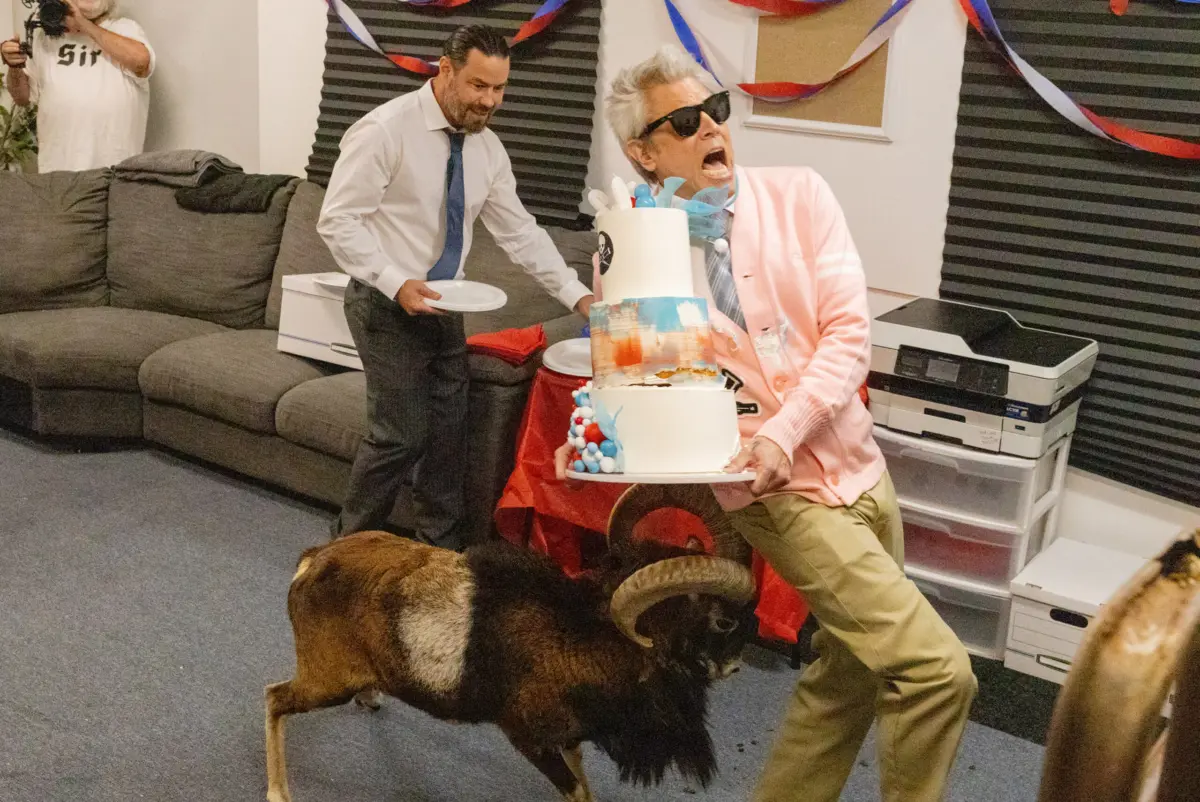
The physical toll on the cast mirrored the logistical expansion of the films. During the production of Jackass Forever, Knoxville sustained severe injuries, including broken ribs and a concussion, after being launched into the air by a charging bull. Archival footage included in Jackass: Best and Last reveals the tense, high-stakes decision-making process behind the scenes, highlighting the rigorous psychological boundaries Tremaine had to navigate to capture the required footage without compromising the safety—or the authentic reactions—of his collaborators.
Critical Revaluation and Institutional Acceptance
For the first decade of its existence, the Jackass franchise was routinely dismissed by mainstream film critics as lowbrow, offensive, and devoid of artistic merit. However, a profound shift in critical consensus occurred around the release of Jackass 3D in 2010, which was famously screened at the Museum of Modern Art (MoMA) in New York City. Cultural critics began to analyze the franchise not merely as a collection of sophomoric pranks, but as a legitimate form of avant-garde cinema, slapstick performance art, and sociological anthropology.
Academic and journalistic analyses frequently highlight elements of the franchise that run counter to its coarse surface appearance: the absence of malice, the staunch condemnation of homophobia, the celebration of vulnerability, and the deep, enduring platonic affection shared among the cast members. Despite these elevated interpretations, Tremaine has consistently resisted attempts to intellectualize his work. He maintains that the foundational ethos of the project remains rooted in a straightforward, anti-authoritarian impulse to amplify absurdity rather than construct high art.
This critical revaluation reached its peak with Jackass Forever in 2022, which garnered overwhelmingly positive reviews from major publications, achieving a rare milestone for a long-running comedy franchise: critical approval that increased with each successive installment. Reflecting on this paradox, Tremaine has expressed amusement and mild apprehension regarding the mainstream embrace, questioning whether critical acclaim signals a loss of the anti-establishment edge that initially fueled the project’s success.
Beyond the Franchise: Commercial and Artistic Implications
While Tremaine is inextricably linked to the Jackass universe, his professional portfolio extends beyond the franchise. Among his most unexpected commercial endeavors was the direction of a high-concept, highly stylized safety demonstration video for American Airlines. Rejecting the conventional, dry tone of corporate compliance videos, Tremaine applied his distinct visual rhythm and musical sensibility to the project, resulting in a widely seen piece of corporate media that contrasted sharply with his underground origins.
Music has continuously served as a foundational element of Tremaine’s creative process. Influenced heavily by the DIY ethos of punk rock, skateboarding, and BMX culture, he approaches editing and visual pacing with a musical sensibility. Despite holding a degree in fine arts and maintaining a lifelong practice in painting and drawing, Tremaine views his output across different mediums as part of a single cognitive process. Whether directing multi-million-dollar studio features, curating magazine layouts, or overseeing chaotic stunt sequences, his approach relies on establishing rigid structural boundaries to provoke spontaneous, unscripted human reactions.
Broader Industry Impact
As the release of Jackass: Best and Last signals the potential conclusion of the franchise, the broader implications of Tremaine’s work on contemporary media are becoming clearer. The DNA of Jackass can be observed across a generation of digital content creators, prank-based web series, and modern unscripted television. By proving that a community built on mutual trust, shared vulnerability, and extreme physical comedy could sustain commercial viability for over twenty years, Tremaine and his collaborators permanently expanded the definitions of studio comedy and documentary filmmaking.
Ultimately, Tremaine remains characteristically self-effacing about his place in film history. Approaching sixty years of age, he continues to express mild bewilderment at his own longevity within the entertainment industry, noting that his core creative voice—and his enduring appreciation for base, juvenile humor—has remained largely unchanged since his early days at Big Brother. Whether viewed as high art by museum curators or celebrated as pure, unadulterated nonsense by its creators, the Jackass legacy stands as a singular, unrepeatable chapter in the history of American popular culture.